.svg)

Get started Alarmy
by scanning the QR code
by scanning the QR code

%201.svg)

Sleep isn't passive recovery. Your brain stays active all night — processing memories, regulating hormones, and repairing tissue. What changes between stages is how it works, not whether it's working.
REM sleep sits at the center of that process. Understanding it explains why some nights leave you sharp and others leave you foggy, even when the total hours look the same.
Every night, your sleep cycles through four distinct stages: N1, N2, N3 (the three non-REM stages), and REM. One full cycle takes roughly 90 minutes. Most adults complete four to six cycles per night.
The stages don't just repeat identically. Their proportions shift as the night progresses — and that shift matters more than most people realize.
N1 is the lightest stage, lasting just one to seven minutes. Muscle activity slows, awareness fades, and the boundary between waking and sleeping blurs. A hypnic jerk — that sudden falling sensation — often happens here.
It's easy to wake someone from N1. A door closing is enough.
N2 is where actual sleep takes hold. Body temperature drops, heart rate slows, and the brain starts producing bursts of rapid activity called sleep spindles. These spindles appear to help consolidate memories and filter out background noise.
N2 accounts for roughly 45–55% of total sleep time — the single largest chunk of any stage. The refreshed feeling after a 20-minute nap comes almost entirely from N2.
N3 is the hardest stage to wake from. The brain shifts into slow, high-amplitude delta waves, and the body enters its most intensive repair mode: growth hormone is released, muscles rebuild, and immune function strengthens.
Waking during N3 produces a groggy, disoriented state called sleep inertia. The body wasn't ready to stop what it was doing.
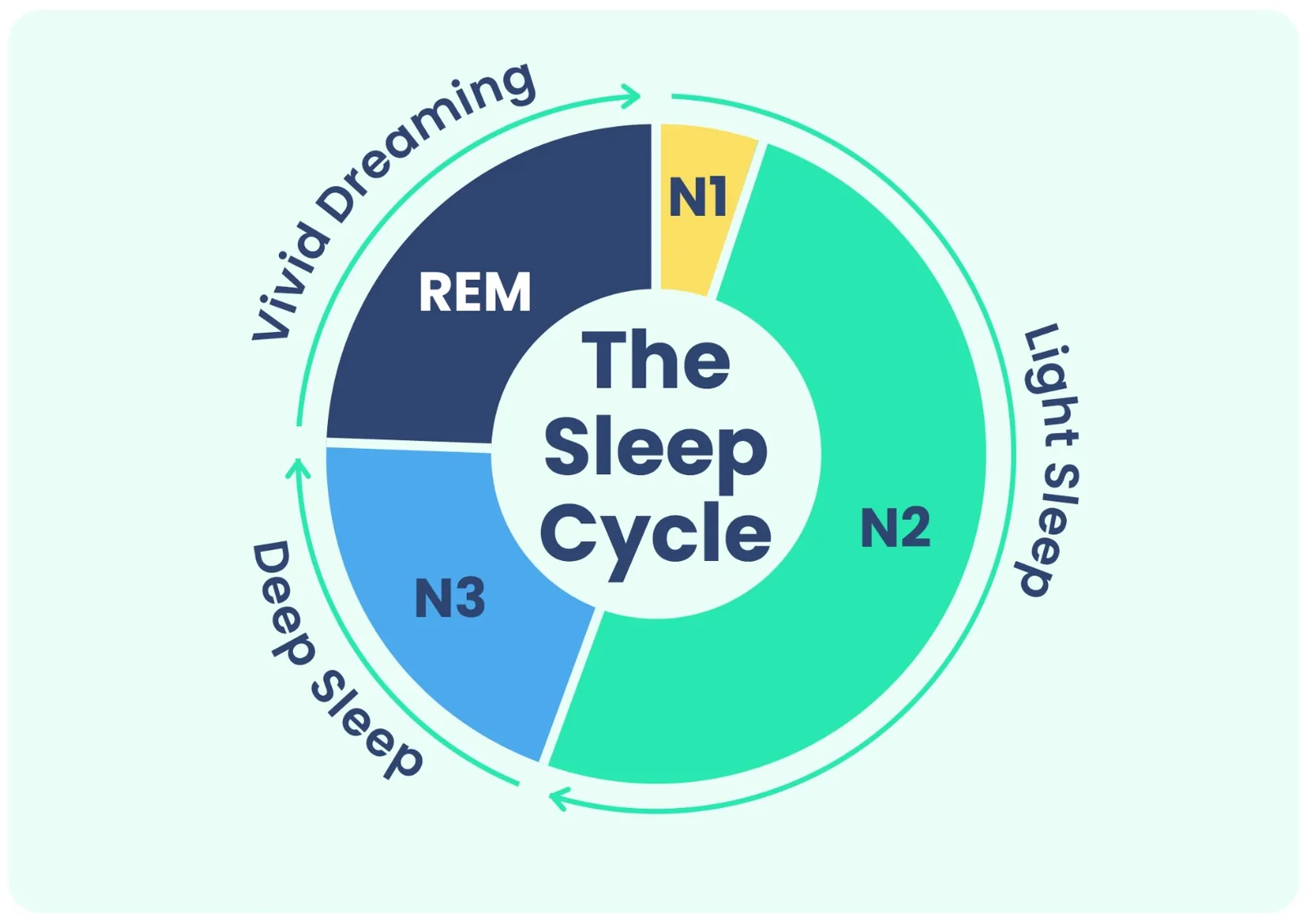
REM stands for Rapid Eye Movement — a name that comes from the distinctive back-and-forth eye movement that occurs beneath closed lids during this stage.
Brain activity during REM looks remarkably similar to waking. The prefrontal cortex — the part responsible for logical reasoning — goes quieter, while areas linked to emotion, memory, and sensory experience become highly active. That's why REM dreams feel so vivid and emotionally charged.
The body, meanwhile, is temporarily paralyzed. Motor signals are blocked at the brainstem, which prevents acting out what's happening in the dream.
Memory consolidation. During REM, the brain replays and integrates information from the day, moving it from short-term storage into long-term memory. This is especially true for emotional memories and procedural skills — language learning, motor sequences, pattern recognition. Studying before sleep and skipping REM is a reliable way to forget what you studied.
Emotional regulation. Research from Matthew Walker's lab at UC Berkeley suggests REM sleep helps strip the emotional charge from difficult memories. The same event feels less raw after a full night's sleep. Cut REM short and the emotional edge stays sharp. This is one reason sleep deprivation and mood dysregulation are so tightly linked.
Creative problem-solving. REM sleep connects loosely related ideas in ways the waking brain doesn't. The insight that wasn't there before bed often appears clearly in the morning — not by accident.
Early cycles in the night are weighted toward N3. That's when the body handles its most urgent physical repair work. As the night continues, each successive cycle allocates more time to REM and less to deep sleep.
The practical consequence: if you sleep six hours instead of eight, you're not losing two hours evenly distributed across all stages. You're losing a disproportionate amount of REM — because it's concentrated in the back half of the night.
This is why cutting sleep short is particularly bad for cognition and mood, even when total hours seem close to normal.
Healthy adults spend roughly 20–25% of total sleep in REM. For an eight-hour night, that's approximately 90 to 120 minutes.
The exact amount varies with age. Infants spend up to 50% of sleep in REM. That proportion drops steadily through childhood and adolescence, stabilizing in adulthood. Older adults typically see a slight decline in both REM duration and intensity.
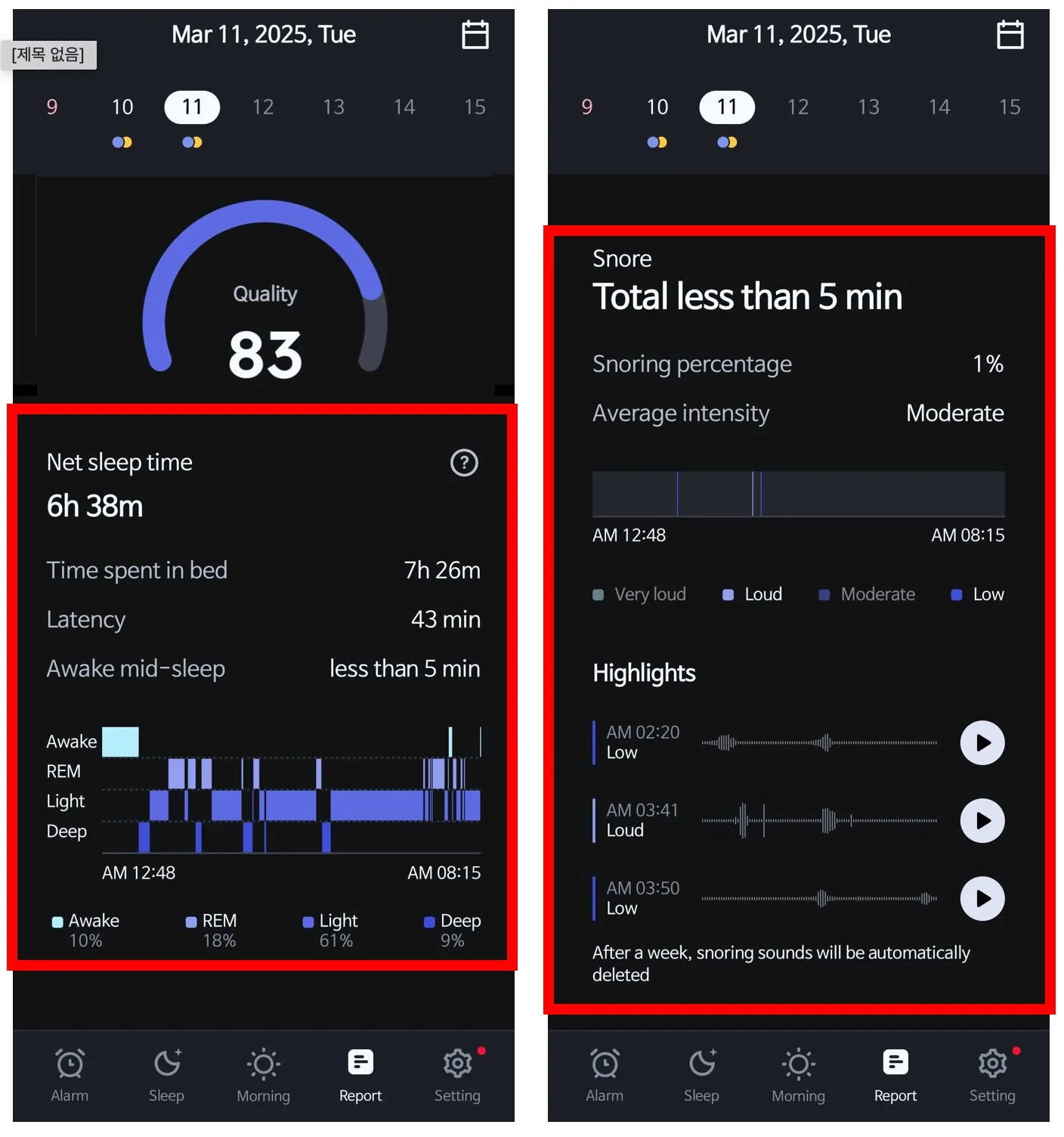
You can't directly target REM the way you'd target a specific muscle group. What you can do is protect the conditions that allow REM to happen naturally.
Keep a consistent wake time. The single most effective thing you can do. A fixed wake time anchors your circadian rhythm, which keeps the sleep cycle structure intact — including the late-night REM window. Sleeping in on weekends disrupts this more than most people expect.
Cut alcohol before bed. Alcohol is sedating, but it suppresses REM. Even moderate amounts consumed within a few hours of sleep reduce REM duration and fragment whatever REM does occur. If you rarely remember dreams on nights you drink, that's why.
Set a caffeine cutoff. Caffeine has a half-life of five to six hours. A 3 p.m. coffee still has half its caffeine active at 9 p.m. Cutting off by early afternoon is a meaningful change for most people, not just an edge case.
Optimize your sleep environment. Temperature, light, and noise have a larger effect on sleep architecture than most people account for. A cool room (around 65–68°F / 18–20°C), complete darkness, and reduced ambient noise all help the brain cycle through stages without disruption. The details are in the sleep environment guide.
Sleep long enough. The simplest lever. Because REM is back-loaded, every extra 30 minutes of sleep adds more REM than it adds to any other stage. If you're consistently sleeping under 7 hours, total duration is likely the first thing to address.
For age-specific guidance on how much sleep you actually need, see ideal sleep hours by age.
Alarmy's smart alarm works with your cycle rather than against it. By waking you at the lightest point near your target time, it avoids pulling you out of deep sleep or REM mid-stage — which is one of the fastest ways to make a good night feel like a bad one.
What does REM sleep do for your brain?
REM sleep handles memory consolidation, emotional processing, and creative association. The brain replays experiences from the day, transfers key information into long-term storage, and regulates the emotional weight of memories. Without sufficient REM, learning efficiency drops and emotional reactivity rises.
What happens if you don't get enough REM sleep?
Short-term effects include difficulty concentrating, impaired memory recall, and increased emotional reactivity. Chronically low REM is associated with higher risk of anxiety, depression, and cognitive decline. Because REM is accumulated in the latter half of the night, sleep deprivation hits it first and hardest.
Does alcohol affect REM sleep?
Yes, significantly. Alcohol suppresses REM during the first half of the night. As it metabolizes, sleep becomes more fragmented in the second half. The net result is less total REM and lower sleep quality — even if falling asleep felt easy.
Can you make up lost REM sleep?
Partially. The brain does prioritize REM on recovery nights, a phenomenon called REM rebound — you spend a higher proportion of sleep in REM after a deficit. But the total amount recovered doesn't fully compensate for what was lost, especially for memory consolidation that needed to happen on specific nights. Consistent sleep is more effective than catch-up sleep.
* This article is for informational purposes only and does not replace professional medical advice. Always consult a healthcare provider for health-related decisions.