.svg)

Get started Alarmy
by scanning the QR code
by scanning the QR code

%201.svg)
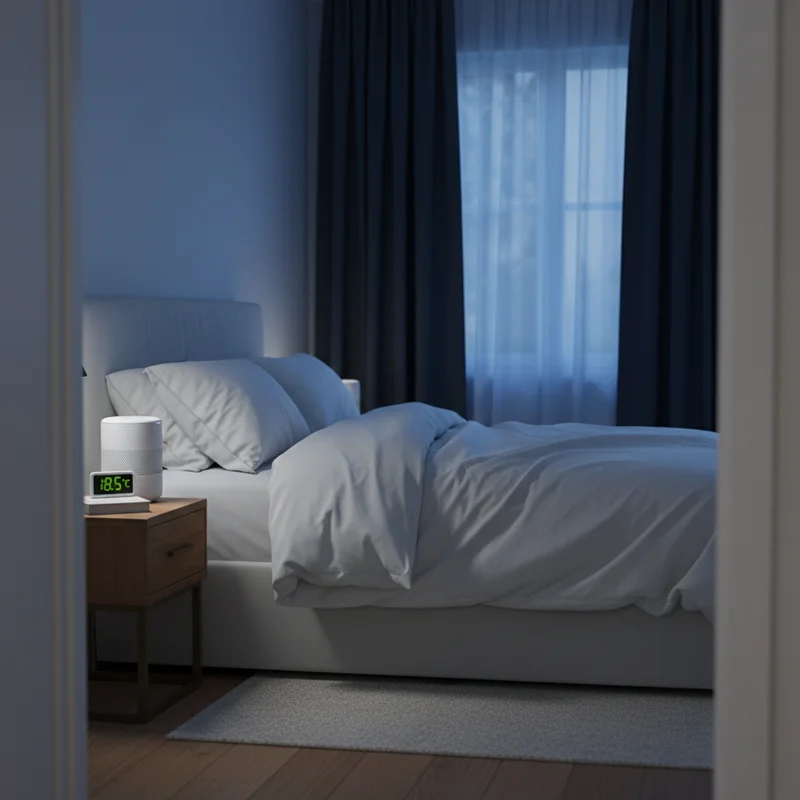
You spend roughly a third of your life in bed — but how much thought have you given to the room itself? Most people invest in mattresses and pillows, then wonder why sleep still feels broken. The problem often sits in the air, the light, and the sounds around you.
Sleep environment optimization comes down to three pillars: temperature, light, and noise. Each one influences distinct biological processes that determine whether you cycle through deep sleep or spend the night tossing. The encouraging part? Fixing most of these costs absolutely nothing.
This checklist walks through all three, starting with free changes you can make tonight and working up to targeted upgrades. By the end, you'll have a clear sleep environment checklist tailored to your bedroom.
Your body needs to drop its core temperature by about 1–2°F to initiate sleep. A warm room fights that process. The Sleep Foundation recommends keeping bedroom temperature between 60–67°F (15–19°C) for most adults — a range that supports the natural thermoregulation your body relies on during the night.
When the room runs too warm, you're more likely to wake during lighter sleep stages. Too cold, and your muscles tense up, making it harder to relax into deeper cycles.
If free fixes aren't enough, a programmable thermostat pays for itself quickly. Set it to lower the temperature automatically 30 minutes before your usual bedtime. Cooling mattress pads are another option — they regulate surface temperature throughout the night.
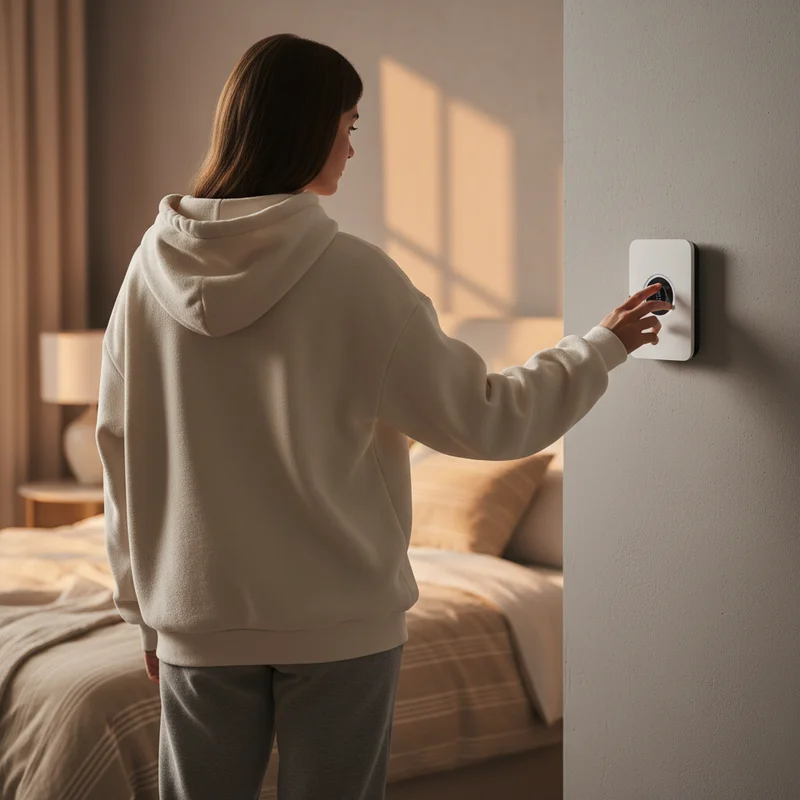
Even dim light exposure at night suppresses melatonin — the hormone that signals your brain it's time to sleep. Research from Harvard Medical School found that ordinary room lighting before bedtime reduced melatonin production by roughly 50%. That glow from a charging phone or a hallway nightlight isn't as harmless as it seems.
Dark room sleep quality improves because your brain receives a clear, uninterrupted "night" signal. Without competing light cues, your circadian rhythm stays on track.
Blackout curtain liners attach behind existing curtains and block over 95% of outside light. They're one of the highest-impact, lowest-cost upgrades for sleep. A contoured sleep mask works well if you share a room and can't control every light source. For more science-backed strategies to fall asleep faster, light control is almost always the first recommendation.
Your brain doesn't fully shut off sound processing during sleep. Sudden noise spikes — a car horn, a neighbor's door, a barking dog — trigger micro-arousals that pull you out of deeper sleep stages. You may not fully wake up, but the damage to sleep architecture accumulates over time.
The World Health Organization considers nighttime noise above 40 dB a risk factor for sleep disruption. For context, a quiet conversation registers around 50 dB.
For a deeper look at sound options, check out these free white noise apps for sleep.
If you live on a busy street or near ongoing construction, a dedicated white noise machine delivers louder, more consistent output than a phone speaker. Place it between your bed and the noise source for the best results.
Run through this checklist to audit your bedroom across all three pillars:
Temperature
Light
Noise
Pick two or three items to tackle this week. Small, stacked changes often produce more noticeable results than one expensive purchase.
Making changes is only half the equation — measuring the impact tells you what's actually working. Before adjusting your room, record a few nights of baseline sleep data. Then make one change at a time and compare.
Alarmy's sleep analysis tracks total sleep time, sleep cycles, and disturbances throughout the night. After a week of environment tweaks, check whether your deep sleep percentage shifted or your wake-up count dropped. That kind of feedback turns a vague "I think I slept better" into something concrete.
Pair environment upgrades with a consistent bedtime routine for the strongest results. The room sets the stage; the routine gets you on it.

Most sleep researchers recommend 60–67°F (15–19°C). Your body needs to cool down slightly to trigger sleep onset, and a room within this range supports that natural process. Personal preference matters too — experiment within the range to find your sweet spot.
Yes. Studies consistently show that dark room sleep quality is higher because darkness allows uninterrupted melatonin production. Blackout curtain liners are a budget-friendly option that blocks most outside light without replacing your existing curtains.
It depends on your environment. In a quiet setting, silence works fine. But if you deal with unpredictable noise — traffic, neighbors, pets — consistent background sound evens out the spikes that cause micro-arousals. White noise, pink noise, and nature sounds all work. The key is consistency.
* This article is for informational purposes only and does not replace professional medical advice. Always consult a healthcare provider for health-related decisions.