.svg)

Get started Alarmy
by scanning the QR code
by scanning the QR code

%201.svg)

"I'm just not a morning person." You've probably said it — or at least thought it — every time an early alarm sounded like a personal attack. And you're not entirely wrong.
Chronotype is the biological pattern that determines whether you naturally feel alert in the morning or late at night. It's shaped partly by genetics, including variants in the CLOCK gene that influence when your body produces melatonin. Night owls don't produce melatonin later because they stay up too late — their body chemistry is wired to release it later. That's a real biological difference, not a motivation problem.
That said, chronotype is not permanent. Research shows it shifts meaningfully across your lifetime — teens tend to run late, adults gradually move earlier. Environment and light exposure also play a role. So while your baseline may lean night owl, it's not sealed in place.
This depends on where you're starting from. There's a clinical condition called delayed sleep phase disorder — where someone's body clock is so far shifted that waking before noon feels physiologically impossible. That's a relatively rare case, and it usually requires medical support.
For most people who identify as night owls, the range of realistic shift is roughly 1 to 2 hours. That's enough to matter. Waking at 7 AM instead of 9 AM opens up mornings in a meaningful way. The mistake is aiming for 5 AM when your natural rhythm is midnight — that's a setup for exhaustion, not transformation.
A more useful reframe: "becoming a morning person" doesn't mean waking at 4 AM. It means consistently waking at your target time without feeling like you're fighting your own body. Set that target realistically, and the path becomes much clearer.
Most people try to shift their wake time all at once. They go to bed "early" one night and set the alarm two hours earlier. They wake up groggy, drag through the day, crash by evening, and repeat — until they give up. The biology here is straightforward: your circadian clock doesn't shift overnight.
A more effective approach works like this:
That last point tends to get skipped. It matters because your circadian clock anchors itself to consistent wake times. Irregular weekends keep it from ever locking in. If snoozing through your weekends keeps undermining your weekday momentum, the shift process will keep restarting. Similarly, once the shift takes hold, building a realistic morning routine gives the new wake time something to anchor to.
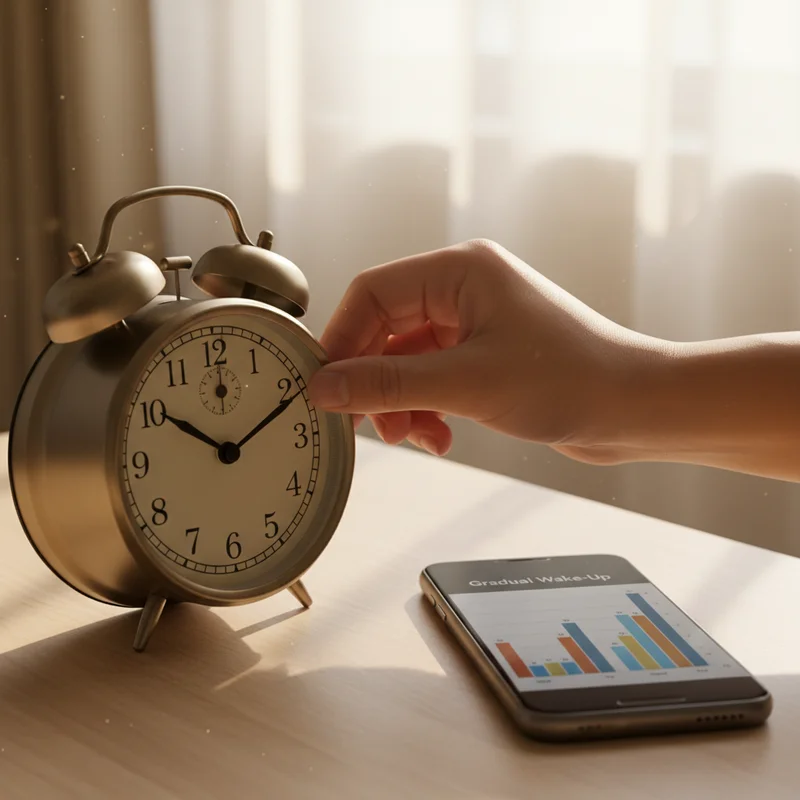
Among all the levers you can pull, light is the most direct. The circadian clock responds to light through photoreceptors in the retina, and morning light sends a clear signal: advance the clock. Getting bright light within 30 minutes of waking suppresses lingering melatonin, spikes cortisol in a healthy way, and tells your brain that this time is morning. According to the Sleep Foundation, light exposure is the primary environmental cue that regulates the circadian rhythm.
The evening side matters too. Blue-wavelength light from screens delays melatonin release, which pushes your body toward sleeping later. Reducing screen brightness or using a blue light filter after 9 PM doesn't require willpower — it just removes a signal that's keeping your clock shifted late.
If you work indoors or live somewhere cloudy, a dedicated light therapy lamp in the morning can substitute for natural sunlight. Even sitting near a bright window for 10 minutes while drinking coffee covers a significant portion of the effect.
Once you've got consistent morning light and reduced evening exposure, building a sustainable morning habit becomes much less of a fight — because your body is actually working with you.

During a wake-time shift, the hardest moment is the minute after the alarm goes off. Your brain is foggy, your bed is warm, and dismissing the alarm feels automatic. Sleep inertia — that heavy, disoriented feeling right after waking — is real and physiological. It typically lasts 15 to 30 minutes and is worst when you wake from deep sleep.
One way to cut through it faster is to make your first action non-trivial. Alarmy's Wake-Up Missions require you to solve a math problem, scan a barcode, or shake your phone a set number of times before the alarm dismisses. By the time you're done, your brain has shifted from automatic to active. That's what breaking sleep inertia actually requires — not caffeine, not cold water.
For the shift plan itself, set your alarm 15 minutes earlier than your current target and use Alarmy's bedtime reminder to anchor the new sleep schedule. The reminder prompts you the night before, making the earlier bedtime an expected transition rather than a surprise. There's also a Fall-Back-Asleep Prevention feature that checks whether you're actually up after dismissing — if you don't respond, missions restart. That layer of accountability matters during the weeks when the new wake time still feels foreign.

At the 15-minute-every-3-to-4-days pace, shifting one hour takes roughly three weeks. Two hours takes six to eight weeks. Consistency matters more than speed — an irregular schedule resets your progress, while a slow but steady shift actually sticks.
Sleeping in slightly — by 30 to 45 minutes — is manageable. Anything beyond an hour starts compressing your circadian shift and reintroduces social jet lag. Think of weekends as maintenance, not recovery from weekdays.
Early tiredness during a shift is expected — your body takes time to resynchronize. Check that your bedtime is shifting in step with your wake time, and make sure you're getting morning light. If fatigue persists after three to four weeks without improvement, consider whether your total sleep time is sufficient.
* This article is for informational purposes only and does not replace professional medical advice. Always consult a healthcare provider for health-related decisions.