.svg)

Get started Alarmy
by scanning the QR code
by scanning the QR code

%201.svg)

Is it really just willpower that separates heavy sleepers from morning people? If you've ever stared at a phone screen at 9 AM with twelve dismissed alarms staring back, you already know the answer is no.
What's actually happening is sleep inertia — the foggy, semi-conscious window right after waking. During this stretch, your prefrontal cortex (the decision-making part of your brain) is barely online, but motor reflexes still work fine. So your hand can find the dismiss button and silence it before you've formed a single conscious thought.
The dismiss tap becomes a learned reflex, like swatting at an alarm clock in the dark. You're not choosing to ignore it. Your brain is running a shortcut. That's also why most regular alarms fail heavy sleepers — a single sound can't override a reflex you've rehearsed every morning for years.
The fix isn't a louder ringtone. It's a system that refuses to take "dismissed" as the final answer.
Alarmy is built on one premise: a half-asleep brain has predictable escape routes, and each route can be blocked. Every layer below targets one specific escape.
The point isn't to use all five at once. Each layer exists because real heavy sleepers actually used those escapes — and Alarmy closed them, one by one. The deeper your sleep, the more layers you stack.
A wake-up mission is a task you must complete before the alarm stops. The dismiss button doesn't appear until the mission is done. That single design choice flips the morning script — your prefrontal cortex has to come online before your finger can shut anything off.
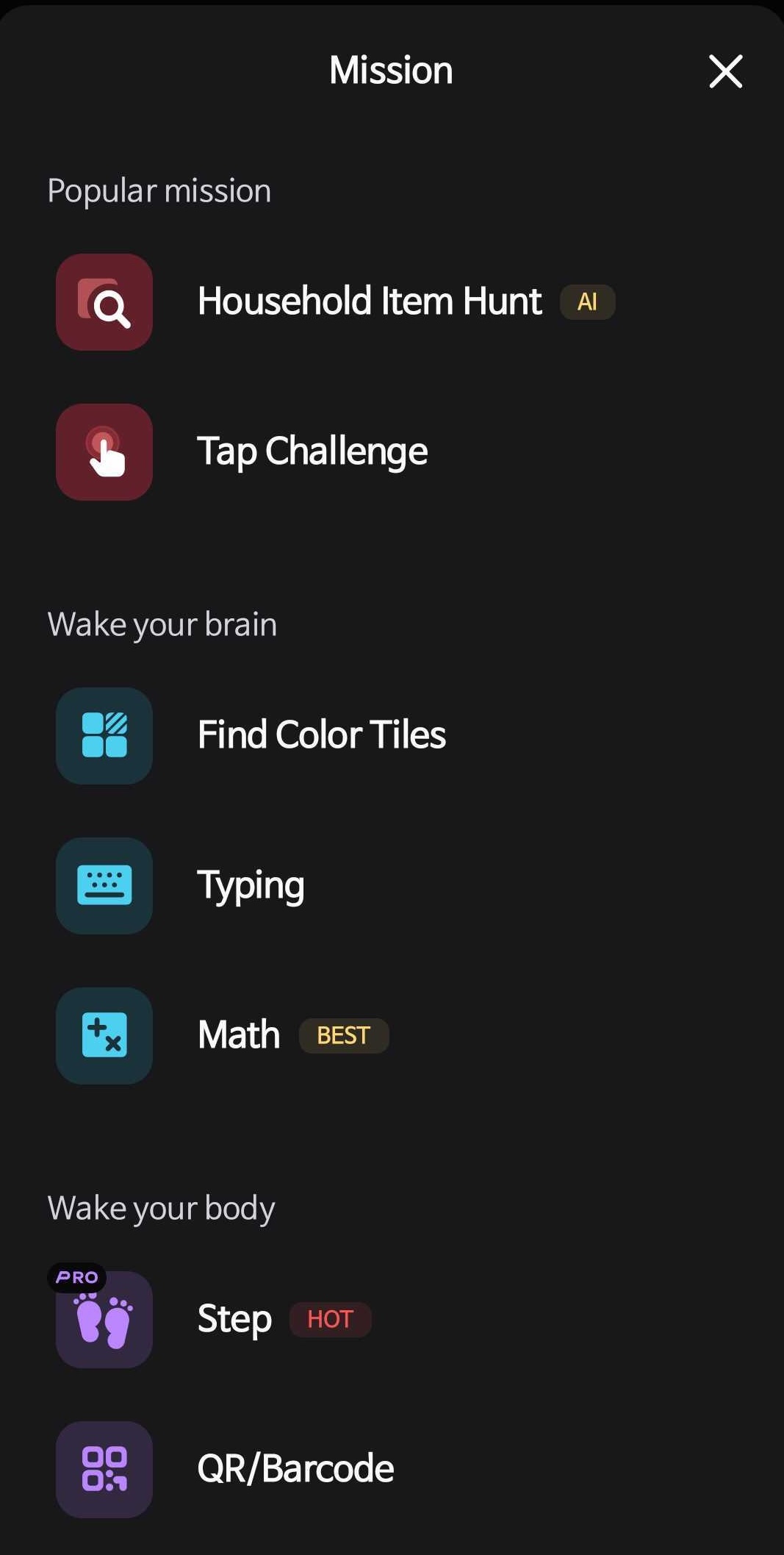
Alarmy offers 10 missions, and they fall into three groups based on what they force you to do.
Cognitive missions push your brain into focused thought. Math gives you arithmetic problems to solve. Memory tiles flash colored squares you have to remember and tap in order. Typing makes you copy a sentence verbatim. Tap challenge demands rapid screen taps within a time limit.
These work because conscious problem-solving and sleep inertia can't coexist for long. Once your brain engages with a math problem, the dismiss reflex loses its grip.
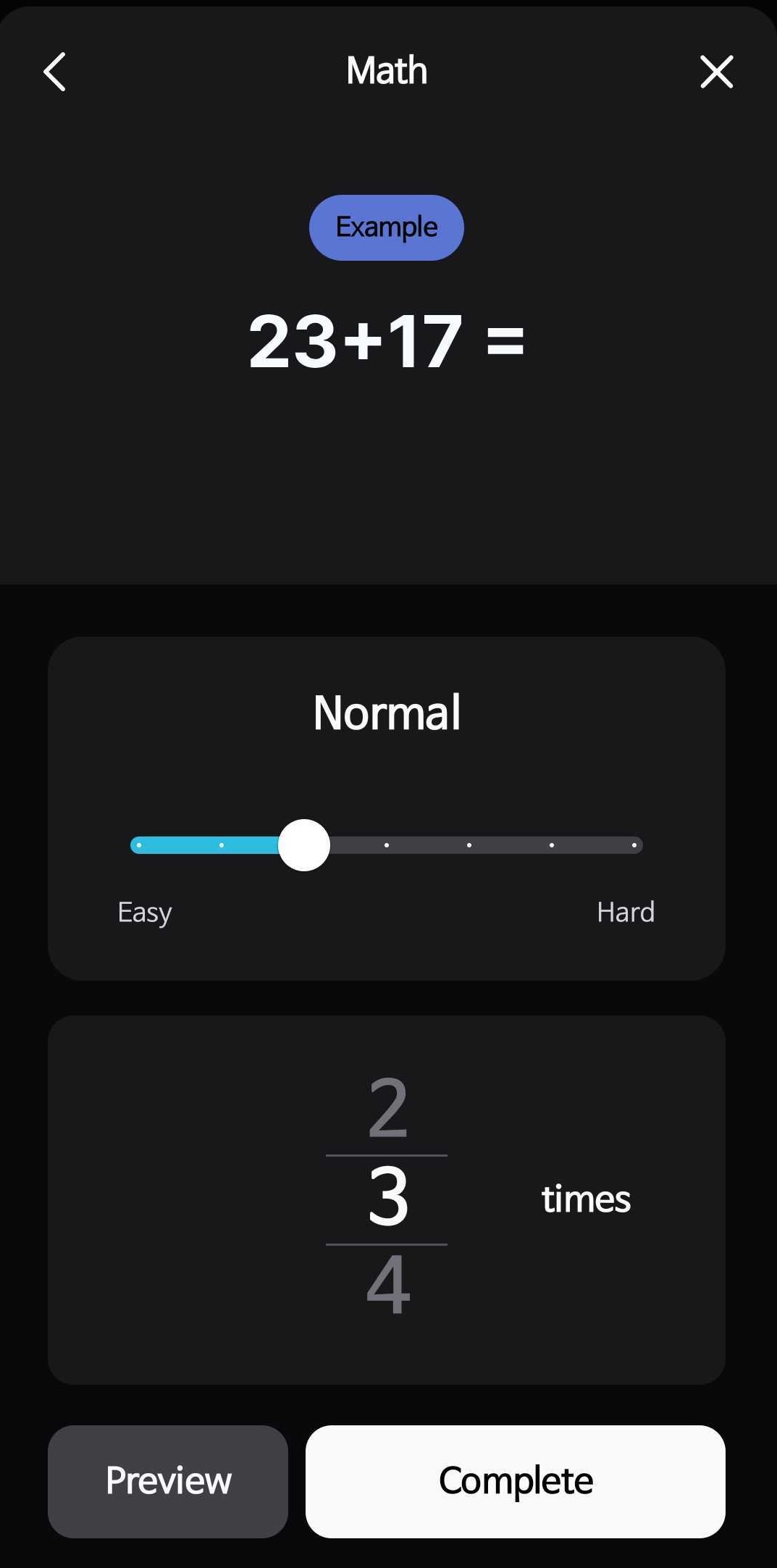
Physical missions force movement. Squat counts your reps using motion sensors. Shake makes you shake the phone a set number of times. Walking requires a step count before the alarm releases.
Movement raises your heart rate and core temperature, both of which help end sleep inertia faster than any sound can. If you can dismiss your current alarm without sitting up, a physical mission is the upgrade.
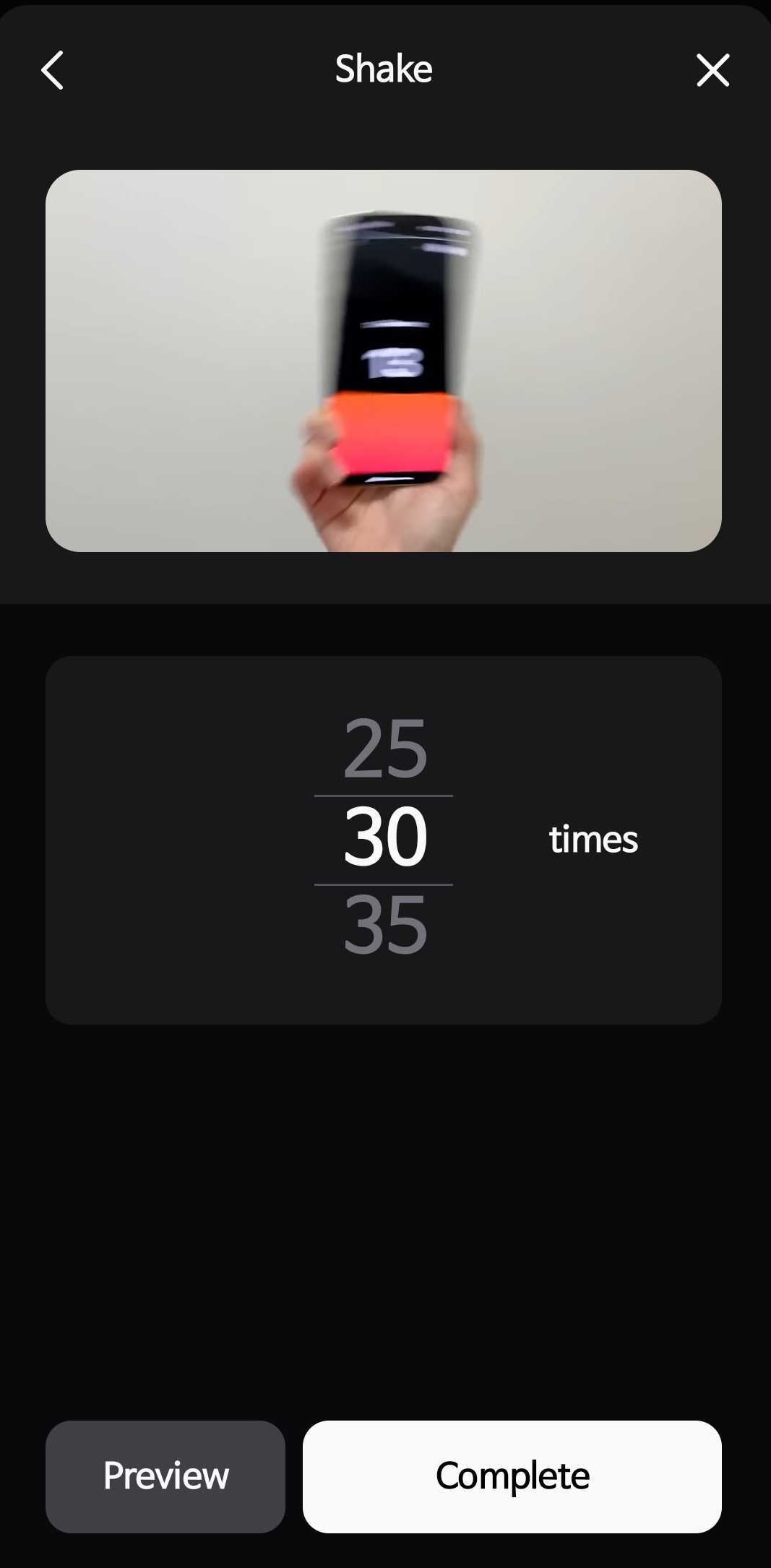
Location-based missions force you out of bed entirely. Photo asks you to retake a pre-set reference shot from the same angle — usually the bathroom sink or the kitchen. QR scans a code you stuck on the fridge or the front door. Household item hunt is the hardest to game: it tells you to find and photograph a randomly assigned object — a fork, a remote, a specific book — and you can't predict which one.
That randomization matters. Muscle memory can't carry you through a task you've never done before.
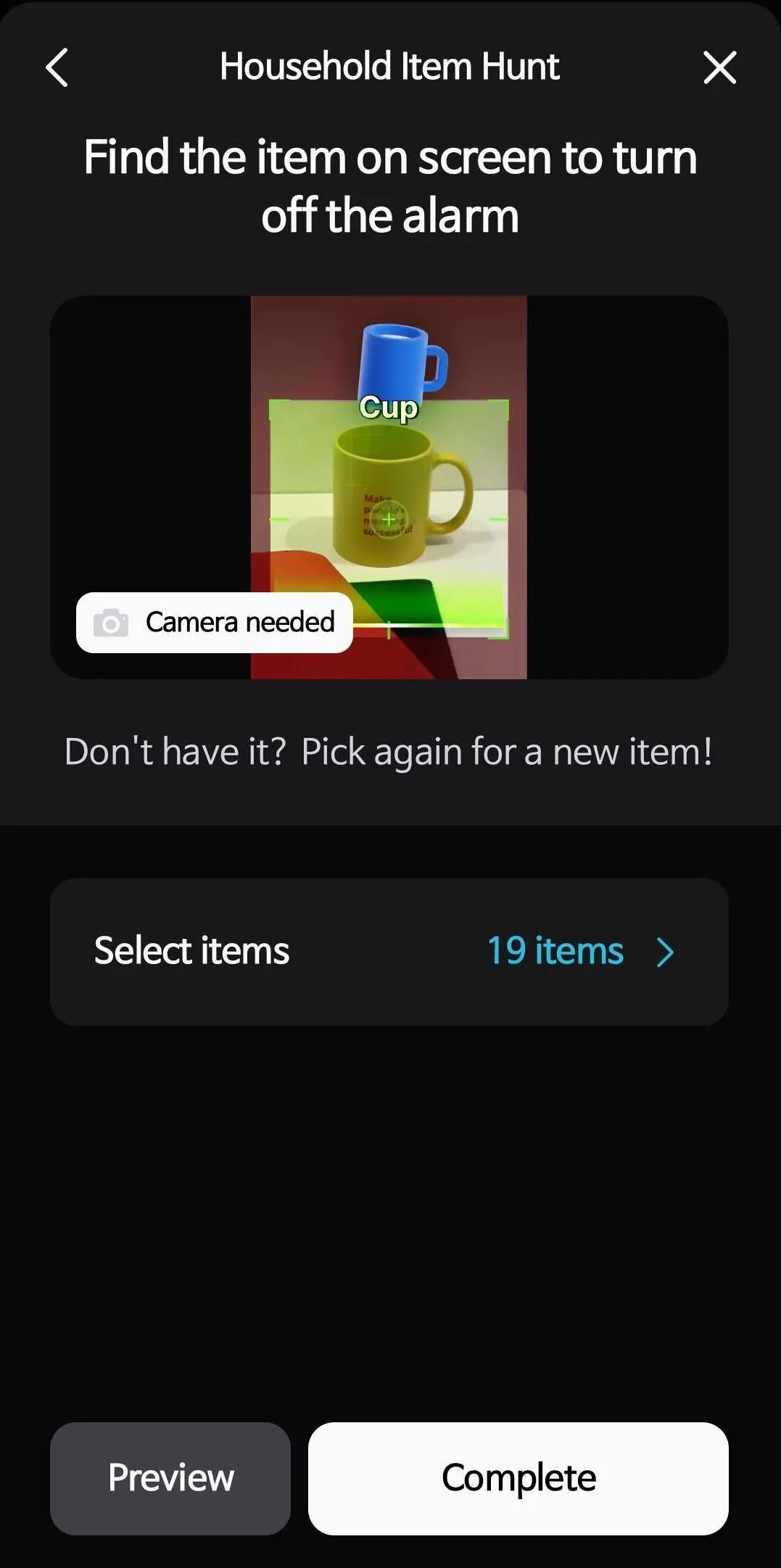
You can chain multiple missions in sequence on a single alarm. A few starting points:
The combo's job isn't punishment. It's making sure you're standing, walking, and thinking before the alarm finally lets go.
Even after completing a mission, the most dangerous moment is the one right after. You stop the alarm, walk three steps, and your body remembers the bed is right there. The "five more minutes" trap doesn't need a snooze button — gravity does the work.
Fall-back-asleep prevention turns dismiss into a checkpoint, not a finish line. After you stop the alarm, Alarmy waits a set window (you choose the duration) and then asks you to confirm you're still up. If you don't respond in time, the missions re-trigger from scratch.

The genius is the timing. The check arrives during the exact moment your guard drops — when you've convinced yourself "I'm awake, I just need to lie down for one second." That's when the missions come back. By the second confirmation cycle, you're usually in the bathroom or pouring coffee, well past the danger zone.
Your brain learns the alarm. Use the same ringtone for two weeks and your auditory cortex starts filtering it as background noise — the same way you stop hearing a refrigerator hum. That's habituation, and it's why a sound that woke you on day one barely registers a month later.
Surprise sound boost adds sudden loud bursts at random points during the alarm. The unpredictability is the whole mechanism. Your brain can filter a steady, repeating pattern, but it can't pre-filter a sound it hasn't heard yet.

Pair this with a mission, and you've got two systems working at once: the surprise burst spikes your alertness, and the mission keeps it there long enough to matter.
For some heavy sleepers, the dismiss button isn't the last line of defense — the power button is. Half-asleep, your hand finds the side of the phone and holds it down. The screen goes dark. The alarm stops. You don't remember any of it.
Power-off prevention blocks that exact escape. With it enabled, the phone refuses to power down while an Alarmy alarm is active.

This sounds extreme until you've done it. Plenty of users only realize they were shutting their phones off at 6 AM after seeing the morning's screenshots from the app.
The final escape route is the strangest one: a half-asleep brain can decide to delete the app. Long-press the icon, hit remove, alarm gone. People have done it, woken up four hours later, and only realized when they reinstalled the app.
Uninstall prevention closes that loop. While an alarm is active, the app can't be removed.
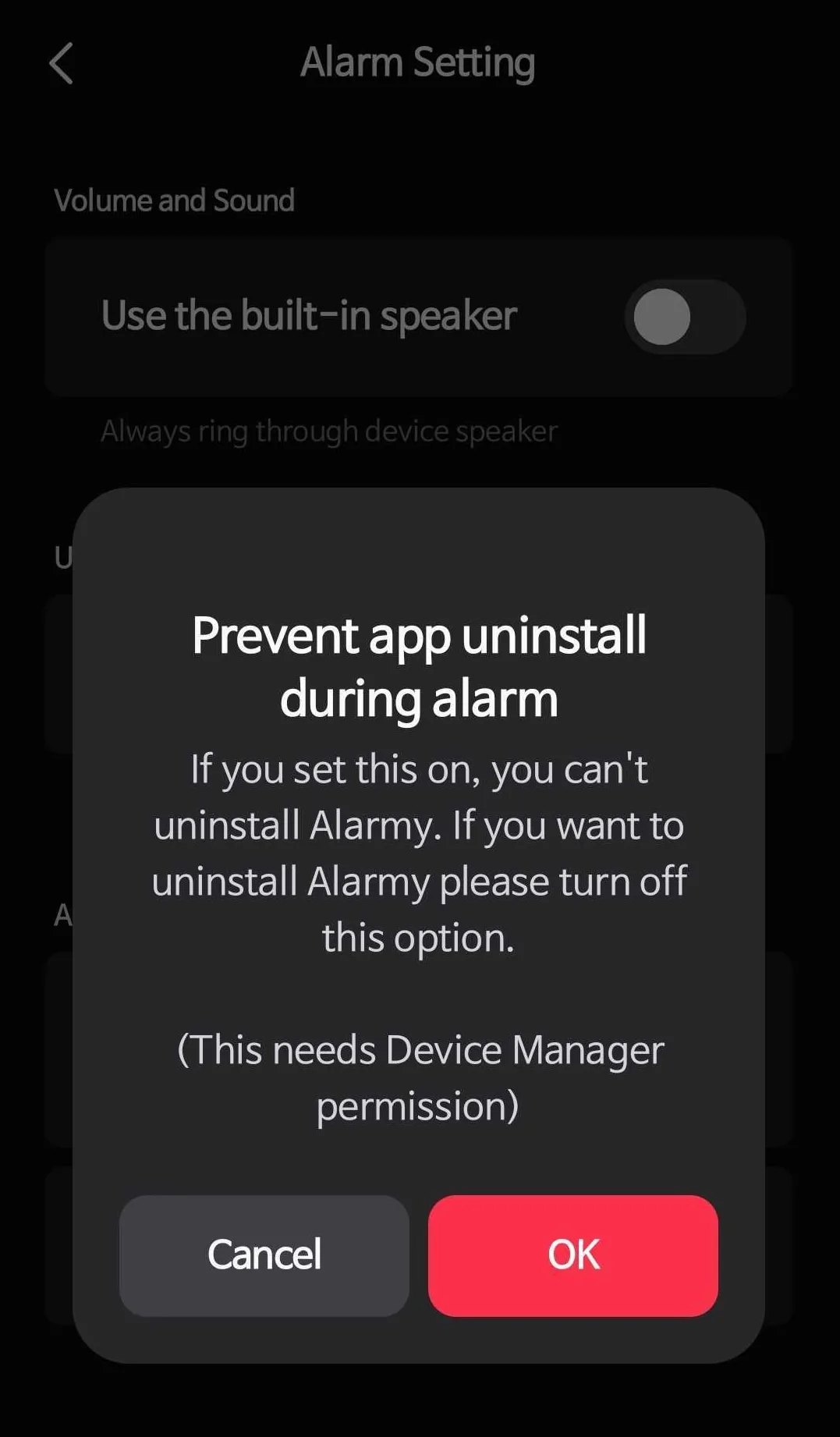
This is the closing layer because it's the last move a desperate, half-conscious brain has left. Stack it on top of the previous four, and the dismiss-and-sleep cycle has nowhere to go.
Not every sleeper needs all five layers. Here are setups that match real morning behavior.
You wake up, but you fall back asleep within minutes if you sit on the bed. Mission: math or memory tiles. Add fall-back-asleep prevention with a 60-second window. That's usually enough to push you into the bathroom and out of the danger zone.
You sleep through normal alarms unless they're loud, and even then you snooze repeatedly. Mission: shake + photo. Add fall-back-asleep prevention and turn on surprise sound boost. The mix of physical movement, a location change, and unpredictable bursts handles most stubborn cases.
You've slept through fire alarms, multiple alarms across the room, or you've woken up to a deleted alarm app with no idea who removed it. Mission: squat + household item hunt + typing. Add fall-back-asleep prevention, surprise sound boost, power-off prevention, and uninstall prevention. The point isn't to make mornings miserable — it's that nothing else has worked, and stacking the layers leaves zero escape routes.
Willpower fails in the first two minutes after the alarm because willpower lives in the part of the brain that hasn't woken up yet. A layered system doesn't ask your half-asleep self to make good decisions — it removes the bad ones from the table. Pick the layers that match your sleep depth, set them once in the Alarmy app, and stop relying on a version of yourself that isn't online when it counts.
Explore 70+ video alarm ringtones to pair with these features →