.svg)

Get started Alarmy
by scanning the QR code
by scanning the QR code

%201.svg)
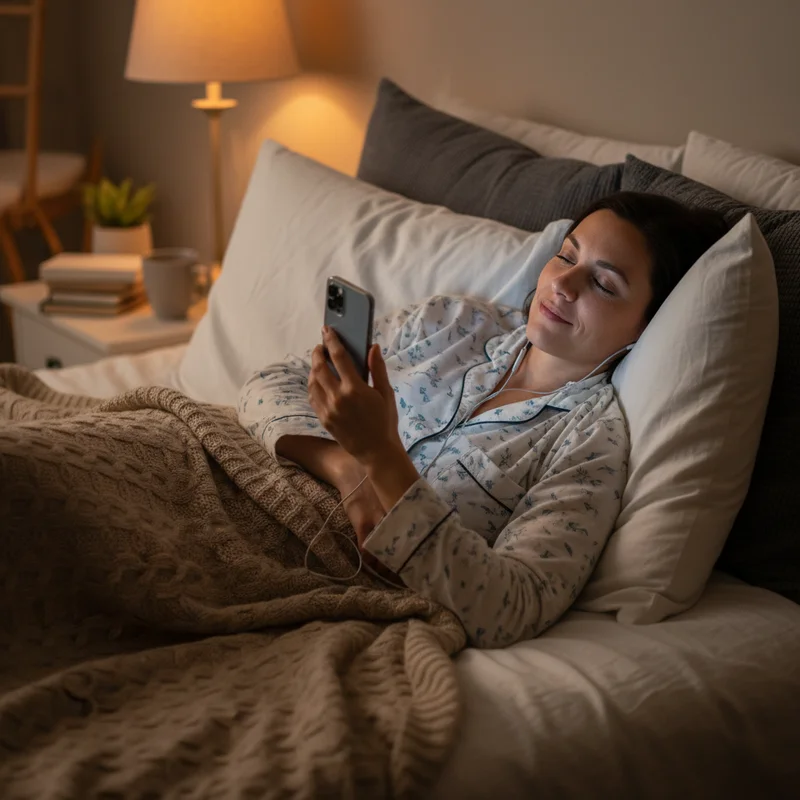
Somewhere between childhood and adulthood, bedtime stories disappeared. Nobody really decided to stop — it just happened. And for a lot of people, sleep got harder around the same time.
Millions of adults have quietly brought them back. Not out of nostalgia, but because they actually work. Podcasts like Sleep With Me have tens of millions of downloads. Calm's Sleep Stories feature is one of the most-used sections of the entire app. This isn't a fringe habit anymore — it's become a mainstream sleep tool.
The question most people have isn't whether it works. It's why a format designed for children would help an adult nervous system settle down. The answer has less to do with nostalgia than with how your brain handles attention during the pre-sleep window.
When you're lying in bed replaying conversations, mentally rehearsing tomorrow's tasks, or just unable to switch off, your brain is caught in an active processing loop. A bedtime story gives it somewhere else to go — a narrative thread to loosely follow without demanding real engagement.
That's not escapism. It's a deliberate redirect. Your attention shifts from your own thoughts to a calm, external voice, and the mental pressure drops enough for sleep to arrive. The story doesn't need to be good. It doesn't even need to be interesting. In fact, the less interesting, the better.
What's actually happening when a story helps you sleep isn't complicated, though the mechanisms are worth understanding.
The core principle is cognitive offloading. According to the Sleep Foundation, the transition to sleep requires a reduction in cortical arousal — the brain needs to downshift. Rumination (replaying worries, making mental lists) keeps that arousal elevated. A monotone narrative provides just enough stimulation to occupy the mind's pattern-seeking tendencies without re-engaging full alertness.
This is similar to how white noise and ASMR function, but with a key difference: stories have structure. The expectation of "something happening next" keeps you loosely engaged — just enough to stop your own thoughts from filling the space. Most people drift off before anything significant happens in the story. That's the whole design.
Research on relaxation and sleep onset suggests that reducing pre-sleep cognitive activity — often called "cognitive arousal" in sleep science — is one of the most reliable ways to shorten the time it takes to fall asleep. Bedtime stories address this directly by providing a passive, low-demand focus object for the mind.
There's also a conditioned response at play. For many adults, being read to was part of falling asleep as a child. Re-creating that auditory environment can trigger the same physiological associations — lower heart rate, relaxed muscles, reduced mental activity. Your brain has done this before and still remembers how. Over time, the habit reinforces itself: the more consistently you listen before sleep, the stronger the association becomes.
For context on how environmental cues interact with sleep onset, building a consistent sleep environment follows the same logic: repeated signals train the body to expect sleep.
Here's the practical part. The options range from completely free to premium subscriptions, and the best choice depends more on your preferences than your budget.

YouTube has a surprisingly deep library of sleep stories for adults. Search "bedtime stories for adults free" and you'll find narrated stories ranging from 20 minutes to several hours. Channels focused on sleep narration keep things deliberately low-key — not dramatic, not too quiet, just steady. Look for consistent upload schedules and a calm, unhurried narration pace when choosing a channel to stick with.
On Spotify, several sleep story playlists and albums are available on the free tier. Search "sleep stories" or "bedtime stories for adults" to browse. Audio quality varies considerably across creators, so listen to the first minute of a few before committing to one. The free tier includes occasional ads, which can be disruptive — most sleep-focused listeners either upgrade or download episodes in advance.
Each of these is free to try. Start with whichever format appeals to you — long-form stories, short meditations, or meandering monologues — and adjust from there. Personal preference matters more than any recommendation.
Calm has a dedicated Sleep Stories section with professional narrators and original content. The production quality is noticeably higher than free options — ambient sound design, careful pacing, and a consistent library that expands regularly. It requires a subscription, but the sleep-specific features are the app's strongest offering for anyone who listens regularly.
Audible works differently — it's an audiobook platform, not sleep-specific. Many users find that slower genres (gentle fantasy, nature writing, quieter literary fiction) work well as sleep audio. The practical advantage is access to full-length books you'll never actually finish, because you'll fall asleep long before the ending. That's a feature, not a flaw.
The platform matters less than how you use it. A few setup choices make a meaningful difference, and they don't require any new apps or gear.
Volume and brightness: Keep volume lower than feels intuitive — around 30-40% on most devices. The goal is audible but undemanding. Pair that with dimmed or off screen brightness; even indirect light exposure suppresses melatonin release, which works against everything the story is trying to do. Ideally, put the phone face-down or out of reach once you've pressed play.
Sleep timer: Most podcast and streaming apps have a built-in sleep timer. Set it for 30-45 minutes. You almost certainly won't need the full duration, but it prevents audio from looping all night. On some apps, this is listed under settings or "sleep" in the playback menu.
Consistency: The biggest factor isn't which story you pick — it's when you listen. Listening at the same time each night, as part of a fixed pre-sleep sequence, builds a conditioned response faster than switching platforms or stories constantly. If you're building a broader bedtime routine for better sleep quality, the story works best as the final, non-screen element before lights out.
One common trap: spending 15 minutes browsing for the "perfect" story before actually settling in. That active searching is the opposite of what you need. What not to do when you can't sleep covers this pattern — passive settling beats deliberate searching every time. Pick something adequate, press play, and stop optimizing.

Subjective improvement ("I think I'm falling asleep faster") is useful, but not the whole picture. After a week of consistent bedtime story listening, pay attention to two things: how long it takes to feel drowsy after getting into bed, and how often you wake during the night.
If you want more precise data, Alarmy's sleep analysis tracks sleep onset time and overnight patterns automatically. Running it for a week before starting the habit — and a week after — gives you an actual baseline to compare against, rather than relying on memory. Changes in sleep onset time are often measurable within 7-10 days of consistent practice.
* This article is for informational purposes only and does not replace professional medical advice. Always consult a healthcare provider for health-related decisions.