.svg)

Get started Alarmy
by scanning the QR code
by scanning the QR code

%201.svg)

It's 3 a.m., you're five energy drinks deep, and you feel like you finally understand Chapter 12. You highlight one more paragraph, run through the flashcards again, and think: "I've got this."
Then the exam lands on your desk. The concepts you reviewed hours ago feel blurry. Your brain stalls on questions you could answer last night. You walk out knowing you bombed it — and the worst part is you can't figure out why.
This is the all-nighter paradox. Getting proper sleep before exams feels like wasted time, but skipping it wrecks the very recall you spent all night building.
Sleep deprivation creates a cruel illusion. Your brain loses the ability to judge its own performance, so you feel sharp while your actual recall crumbles. A study published in the journal Sleep found that students who pulled all-nighters rated their preparedness higher than their peers — yet scored lower on the test.
That late-night confidence? It's your tired brain lying to you.
The reason all-nighter studying backfires isn't about effort. It's about biology.
When you study, new information first lands in the hippocampus — a temporary holding area. During deep sleep stages, your brain replays that information and transfers it to the cortex for long-term storage. This process, called memory consolidation, relies heavily on slow-wave and REM sleep.
Skip sleep, and you skip the transfer. The material stays fragile, easily overwritten or forgotten under exam pressure.
According to research from the National Institutes of Health, staying awake for 18 hours straight degrades reaction time, working memory, and decision-making to levels comparable to a blood alcohol concentration of 0.05%. Push past 24 hours, and cognitive impairment reaches 0.10% — above the legal driving limit in most countries.
You wouldn't take an exam drunk. But that's roughly what all-nighter studying does to your brain. Your prefrontal cortex — the region responsible for logical reasoning and problem-solving — takes the hardest hit. Essay questions, multi-step math problems, and anything requiring critical thinking suffer the most.

A Harvard Medical School study tracked students across exam periods and found that those who slept at least six hours retained significantly more material than those who studied through the night. The sleep group didn't study more — they just held onto what they'd already learned.
Sleep and memory consolidation work together. Six hours gives your brain enough slow-wave cycles to move the day's learning into stable, retrievable memory. Less than six, and the consolidation process gets cut short.
Every hour of study you add past midnight offers less return than the hour before. Your attention narrows, reading speed drops, and you start re-reading the same paragraph without absorbing it. Meanwhile, sleep debt accumulates with real cognitive costs that don't disappear with coffee.
Trading sleep for study time feels productive. The data says otherwise. Prioritizing sleep before exams is one of the simplest ways to protect hours of studying you've already done.
Most students set a vague bedtime and hope for the best. A solid student sleep schedule during exam week needs more structure than that. The best approach is reverse calculation — working backward from your exam to figure out exactly when to sleep.
Write down when your first exam starts. If it's at 9:00 a.m., that's your anchor point. Everything else flows backward from here.
Give yourself 90 minutes before the exam for getting ready, eating, and a final review. For a 9:00 a.m. exam, that means waking up at 7:30 a.m.
Count back 7 hours from your wake-up time. That puts your bedtime at 12:30 a.m. If you can only manage 6 hours, shift to 1:30 a.m. — but treat 6 hours as the absolute floor.
Write this student sleep schedule on a sticky note and put it where you study. When the clock hits your bedtime, close the textbook. The material you'd cover in that extra hour won't stick anyway — your brain needs those hours of sleep before exams to lock everything in.
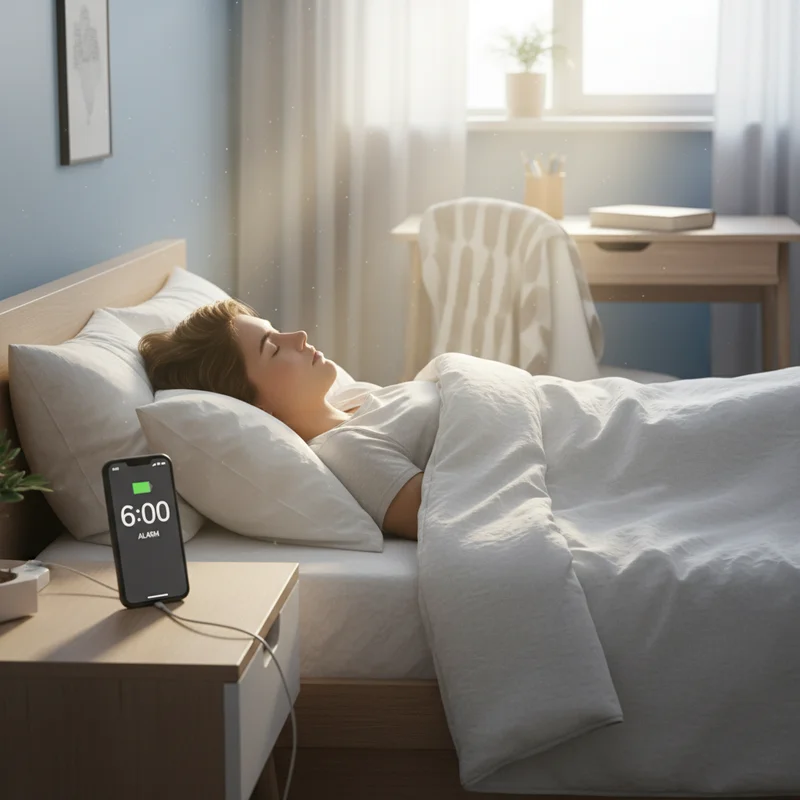
A schedule only works if you follow it. During exam week, two moments matter most: the moment you stop studying at night and the moment you wake up in the morning.
Oversleeping an exam is every student's nightmare. A regular alarm is easy to dismiss while half-asleep. Alarmy's wake-up missions — math problems, photo tasks, or shake challenges — force your brain to engage before the alarm stops. You can't sleepwalk through it.
The hardest part of the schedule isn't waking up. It's closing the book at 12:30 a.m. when you feel like there's more to cover. Set a bedtime reminder that acts as an external "stop" signal — removing the decision from your tired, motivated brain.
Alarmy's sleep analysis lets you check whether you're actually getting those six-plus hours. During a stressful exam week, it's easy to overestimate how much you slept. Having real data keeps you honest and helps you adjust your schedule if needed.

Four hours is better than zero, but it's not enough for full memory consolidation. Most slow-wave sleep — the stage responsible for transferring studied material to long-term memory — happens in the first 5-6 hours. Aim for at least six hours of sleep before exams to give your brain a realistic chance at retaining what you studied.
A 20-minute nap can boost alertness temporarily, but it doesn't replace a full night of sleep. Naps don't provide enough slow-wave or REM sleep to consolidate complex material. Use naps as a supplement, not a substitute.
Pre-exam anxiety can make it hard to fall asleep even when you're tired. Avoid screens for 30 minutes before bed, keep the room cool, and try slow breathing (4 counts in, 6 counts out). If you're still awake after 20 minutes, get up briefly and do something calm — then try again.