.svg)

Get started Alarmy
by scanning the QR code
by scanning the QR code

%201.svg)

You slept seven hours on Tuesday and woke up sharp. You slept seven hours on Thursday and could barely function. Same duration, completely different outcome.
Total sleep time is only part of the equation. When you wake up — specifically, which stage of sleep you interrupt — determines whether those seven hours feel like a full recharge or a rough night. Your body cycles through light sleep, deep sleep, and REM in roughly 90-minute blocks. Waking at the tail end of a cycle feels natural. Waking in the middle of deep sleep triggers grogginess that can linger for hours, regardless of how long you were asleep.
That's why "how much sleep do you need" is actually two questions: how many total hours, and when should you wake up within those hours? The answer depends on both your age and your sleep cycle timing.
The National Sleep Foundation published consensus guidelines based on age groups. These aren't arbitrary — they reflect hundreds of studies on cognitive performance, immune function, and long-term health outcomes.
Notice that every age group has a two-hour window, not a single number. Genetics, activity level, and overall health all influence where you fall within the range. Some adults genuinely function well on seven hours. Others need a full nine. Claiming everyone should sleep exactly eight hours ignores significant individual variation. Understanding your ideal sleep time by age is just the starting point — you still need to find where you land within the range.
The risk of accumulating sleep debt by cutting corners during the week grows when you assume you're on the lower end of the range without actually testing it.
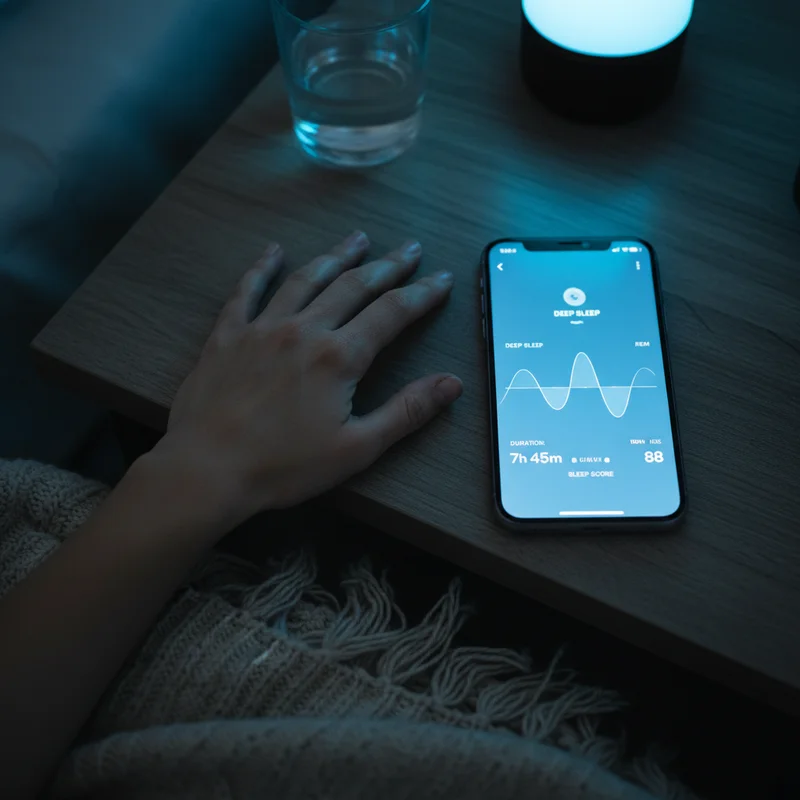
Each night, your brain moves through four to six complete sleep cycles. A single cycle lasts about 90 minutes and progresses from light sleep (stages 1-2) through deep sleep (stage 3) and into REM sleep. Early cycles are heavier on deep sleep. Later cycles shift toward longer REM periods, which is why most vivid dreams happen toward morning.
Alarm clocks don't know which stage you're in. If your alarm fires during deep sleep, your brain struggles to transition to wakefulness — a state called sleep inertia. It's the reason eight hours can sometimes feel worse than six and a half. The total matters, but the exit point matters just as much.
So how much sleep do you need, in practice? A useful way to align your sleep with natural cycles: count backward from your target wake time in 90-minute intervals. If you need to wake at 6:30 AM, ideal bedtimes (accounting for about 15 minutes to fall asleep) would be 11:15 PM (five cycles), 9:45 PM (six cycles), or 12:45 AM (four cycles). This approach works as a basic sleep calculator — not perfectly precise, but far better than picking an arbitrary bedtime.
General guidelines tell you the range. Finding your actual optimal sleep duration — the precise number of hours where you consistently feel rested — requires a short experiment.
Pick a two-week stretch where your schedule is relatively stable. Set a consistent bedtime — early enough to allow your maximum suspected need (say, nine hours). Don't set an alarm. Let your body wake up naturally each morning.
For the first three to four days, you'll likely oversleep as your body clears any existing sleep debt. After that initial recovery phase, your natural wake time will stabilize. The average sleep duration during the second week is a strong indicator of your personal optimum.
Record four things each morning: what time you went to bed, what time you woke up, total hours slept, and how you feel on a 1-5 scale. By the end of week two, a pattern emerges. Most adults land between 7 and 8.5 hours once the debt is cleared.
The key insight from this experiment: there's often a gap between how much sleep you think you get and how much you actually get. Time in bed isn't the same as time asleep. Using a sleep tracking tool — like the sleep analysis feature in Alarmy — reveals your real numbers. You might discover that your "eight hours in bed" is closer to six and a half hours of actual sleep once you subtract the time spent falling asleep and brief overnight awakenings.
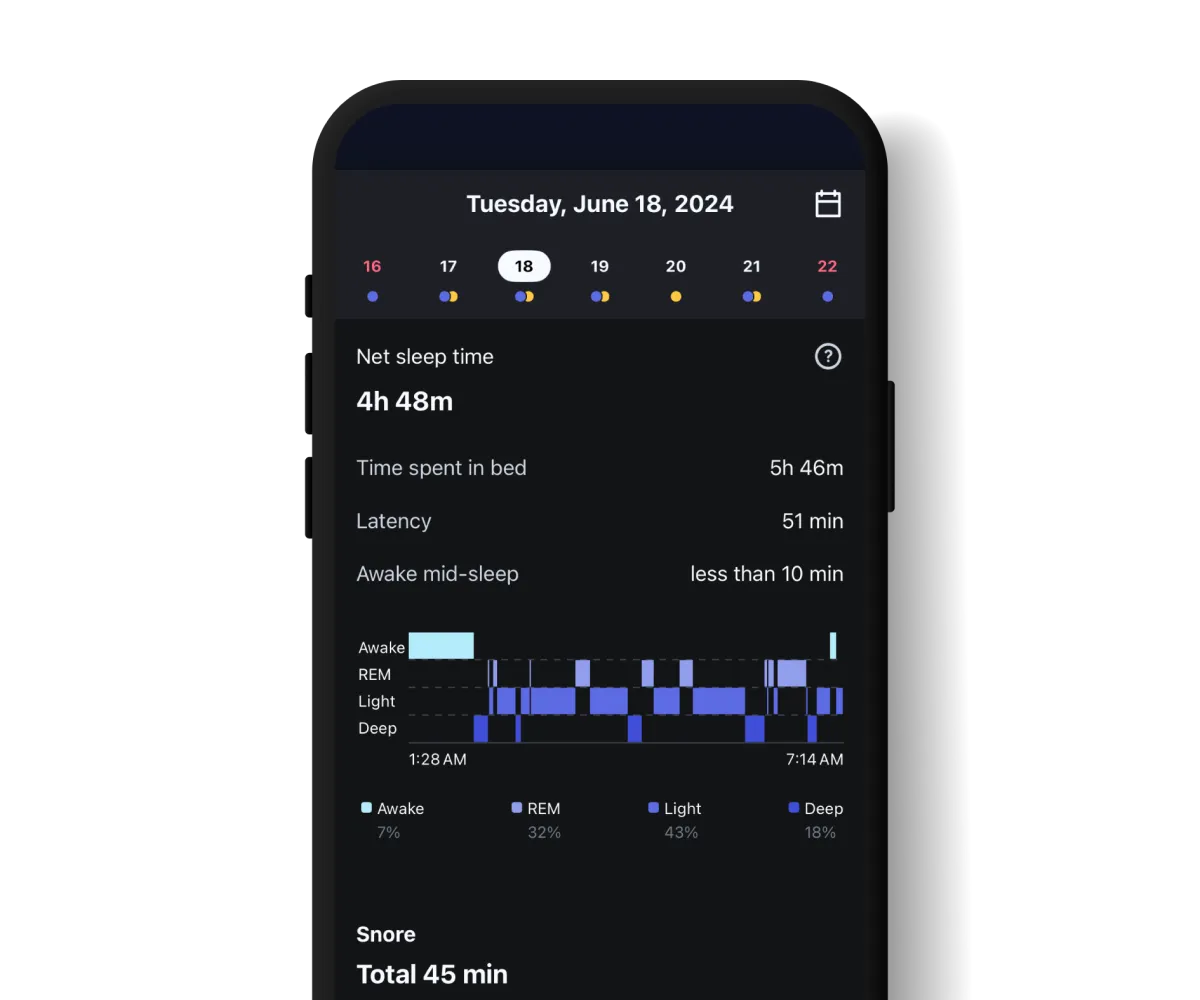

Once you know your ideal sleep duration from the experiment, the next step is maintaining it consistently. Knowing how much sleep you need is only useful if you actually get that amount each night. Sleep tracking turns a one-time experiment into an ongoing habit. Monitoring your actual sleep time each night — not just when you set your phone down — keeps you honest about whether you're hitting your target.
Pairing that knowledge with cycle-aware alarm timing closes the loop. Alarmy's gentle wake-up feature gradually increases alarm volume as you near the end of a cycle, reducing the jarring mid-deep-sleep wake-ups that make mornings feel brutal. The combination of sleeping the right number of hours and waking at the right moment within those hours is what separates a refreshed morning from a groggy one.

For most adults, no. The National Sleep Foundation's minimum recommendation for ages 18-64 is seven hours. Some people carry a gene variant (DEC2) that allows them to function on six hours, but this is extremely rare — estimated at less than 1% of the population. If you need caffeine to get through the afternoon, six hours probably isn't enough.
Slightly. Older adults (65+) need 7-8 hours compared to the 7-9 hour range for younger adults. However, the decrease is smaller than most people assume. What changes more noticeably with age is sleep architecture — older adults spend less time in deep sleep and wake more frequently during the night, which can make the same number of hours feel less restorative.
Consistently sleeping more than nine hours (for adults) is associated with health concerns including higher rates of depression, cardiovascular issues, and increased mortality in some studies. However, oversleeping is often a symptom of an underlying condition rather than a cause. If you regularly need 10+ hours and still feel tired, it's worth discussing with a doctor.
* This article is for informational purposes only and does not replace professional medical advice. Always consult a healthcare provider for health-related decisions.