.svg)

Get started Alarmy
by scanning the QR code
by scanning the QR code

%201.svg)
You know the routine. You fall asleep warm and comfortable, then wake up at 3 AM shivering because your partner has cocooned themselves in the entire duvet. Or maybe you're the one who runs hot and kicks the blanket off, leaving them cold.
Sharing one blanket sounds romantic until it starts wrecking your sleep. Cover-stealing, temperature clashes, and every toss or turn rippling across the bed — these are real problems that affect how deeply both partners rest.
A 2016 study from Paracelsus Private Medical University found that couples experience more nighttime movement disruptions when sharing bedding compared to sleeping solo. Each partner has a different body temperature, different comfort preferences, and different movement patterns. One duvet forces two people into a compromise neither body actually wants.
The result? More micro-awakenings, lighter sleep stages, and that familiar morning grumpiness neither of you earned.
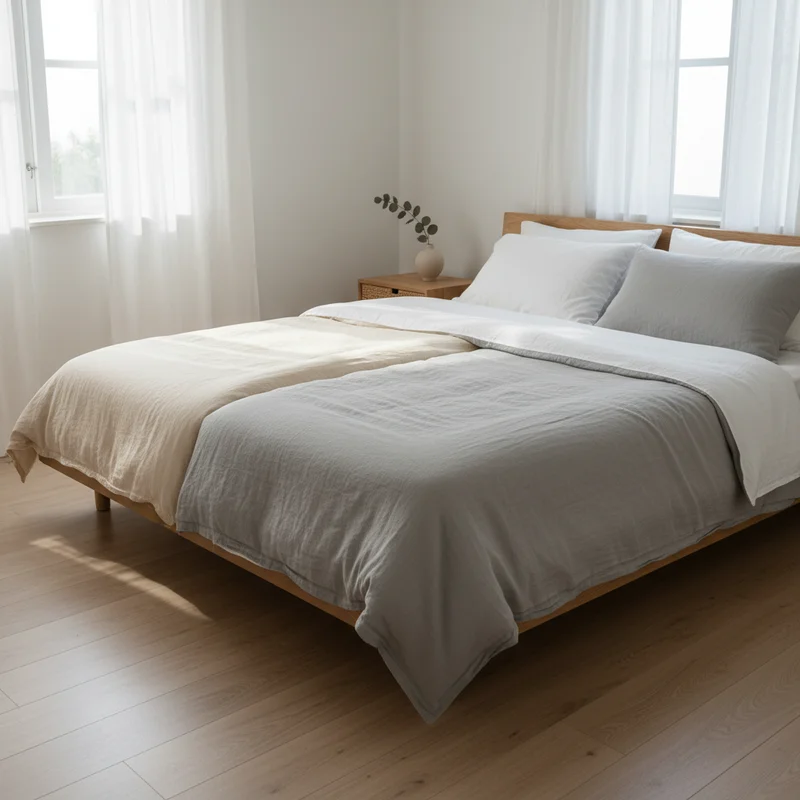
The Scandinavian sleep method is a Nordic bedding practice where two people share one bed but sleep under separate blankets for couples. Each person gets their own single-size duvet, eliminating the nightly tug-of-war while keeping the intimacy of a shared mattress.
The concept is simple. Take your queen or king bed, remove the shared comforter, and replace it with two individual duvets. Each person wraps up in their own cover. During the day, you can fold or layer them neatly for a tidy look.
No special equipment required. No bed dividers, no sleep divorce, no separate rooms. Just two blankets instead of one.
In Denmark, Sweden, Norway, and Finland, this has been standard for decades. Most Scandinavian hotels default to this setup — twin duvets on a double bed. It's not considered unusual or a sign of relationship trouble. It's simply practical. The Nordic approach treats individual sleep comfort as a priority, not a compromise.
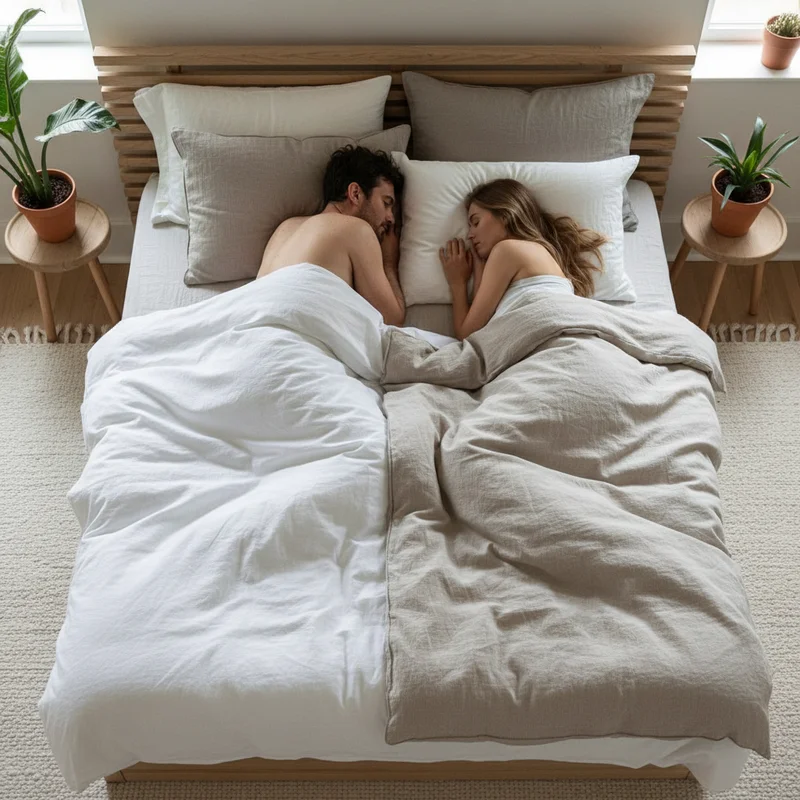
The two duvet method addresses several common sleep disruptors at once. Here's what changes when each person controls their own blanket.
When your partner rolls over or adjusts their blanket, you don't feel it. Your duvet stays in place regardless of what happens on the other side of the bed. This alone reduces those middle-of-the-night wake-ups caused by a sudden draft or a yanked cover.
Think about how many times per night you semi-wake because the covers shifted. Most people don't even register these micro-arousals, but they fragment sleep cycles and reduce time spent in deep, restorative stages.
Body temperature is one of the biggest factors in sleep quality. Your bedroom environment matters more than most people realize, and blanket choice is part of that equation. One partner might prefer a thick down duvet while the other sleeps best under a lightweight cotton cover. Separate blankets for couples make this possible without negotiation.
Research from the American Academy of Sleep Medicine shows that environmental disturbances — including bedding movement — contribute to fragmented sleep. With each partner under their own duvet, the number of disruptions drops significantly. More uninterrupted sleep cycles mean better recovery and sharper mornings.
Ready to try the Scandinavian sleep method? A few practical details make the difference between a smooth transition and a tangled mess.
For a queen bed (60x80 inches), two twin-size duvets (140x200 cm or roughly 55x79 inches each) fit well. They cover each person fully without excessive overhang on the sides. On a king bed, you have even more room — twin XL or standard twin duvets both work.
Avoid using two full-size duvets on one bed. The excess fabric bunches up in the middle and defeats the purpose.
This is where personalization shines. Hot sleepers benefit from breathable materials like bamboo, Tencel, or lightweight cotton shells filled with down alternative. Cold sleepers can go heavier — goose down or wool fill with a sateen cover traps warmth effectively.
The beauty of the two duvet method is that each person picks what suits them. No more "running the A/C because your partner needs the heavy blanket" situations.
In summer, both partners might prefer light throws. In winter, one might switch to a thick duvet while the other stays with a medium-weight option. You can even rotate fills seasonally — down for winter, cotton for summer — without coordinating with your partner's preferences.
Keep two sets stored and swap as the temperature shifts. It takes less closet space than you'd expect, especially if you use vacuum storage bags for the off-season set.
Some couples even use a lighter duvet as a top layer over both individual ones during colder months. This adds warmth without forcing a shared-blanket compromise.

Switching blankets feels like a small change, but the impact on sleep quality can be measurable.
Try the method for two weeks and pay attention to how you feel each morning. If you want concrete data, Alarmy's sleep analysis feature tracks total sleep time, sleep cycles, and nighttime wake-ups. Run it for a week before switching, then a week after — the comparison tells you whether the Scandinavian sleep method benefits your specific sleep pattern.
Couples dealing with accumulated sleep debt often notice improvements faster because they're eliminating a nightly disruption source they'd normalized. Even small gains — falling asleep 10 minutes faster, waking up once less per night — compound over weeks into noticeably better energy and mood.

Absolutely. You still share the same bed and can cuddle whenever you want. The separate duvets only come into play once you're ready to fall asleep. Many couples find they actually cuddle more intentionally because it becomes a choice rather than a default blanket position.
Two twin-size duvets (140x200 cm) are ideal for a queen bed. They provide full coverage for each person without too much fabric hanging off the edges. For a king bed, twin or twin XL both work comfortably.
Yes. Fold each duvet in thirds lengthwise and lay them side by side, or drape a decorative throw across the foot of the bed. Many Scandinavian-style bedding brands sell coordinating duvet covers designed for this exact setup.
It started in the Nordic countries but has gained popularity across Europe and North America. Germany, Austria, and Switzerland have used twin duvets for generations as well. Social media — especially TikTok — has recently introduced the method to a much wider audience.
* This article is for informational purposes only and does not replace professional medical advice. Always consult a healthcare provider for health-related decisions.