.svg)

Get started Alarmy
by scanning the QR code
by scanning the QR code

%201.svg)
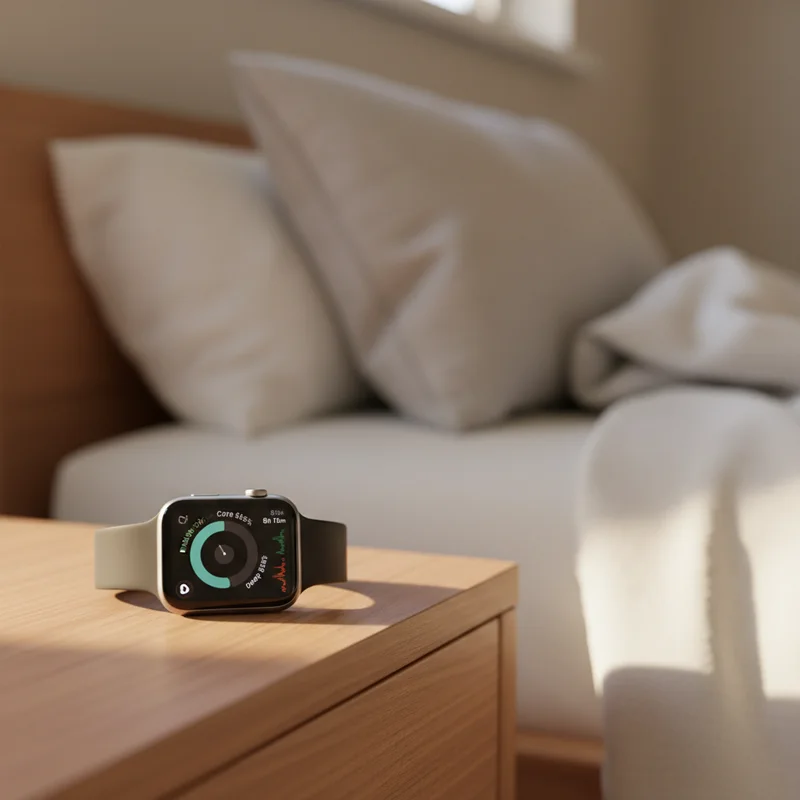
You open your Apple Watch's sleep summary and see three categories: Core, Deep, and REM. Deep sleep sounds serious. REM you've heard of. But "core sleep" — that's a new one.
Most wearable apps started labeling this category without much explanation, and searching online mostly turns up the same vague answer: it's the biggest chunk of your night. That's technically true, but it doesn't tell you what's actually happening or whether your numbers look healthy.
This guide breaks down what core sleep is, why it matters, how it compares to the other stages, and what you can realistically do if you want more of it.
Core sleep refers to NREM Stage 2 (N2) — the intermediate sleep phase that makes up the largest portion of a typical night's rest. During this stage, your brain produces bursts of activity called sleep spindles and K-complexes that help consolidate memories and block out external noise. It's neither the lightest nor the deepest sleep, but it's the phase your body spends the most time in, typically 45–55% of total sleep for healthy adults.

The name comes from its structural role. Core sleep acts as the connective tissue between sleep stages — linking light sleep (N1) to deep sleep (N3) and cycling through REM. Without adequate N2, the whole sleep architecture becomes fragmented.
Apple Watch and most modern wearables adopted "core" as their display label for N2, which is why the term has become so widespread. It's a branding convention, not a new scientific category — sleep researchers have called it NREM Stage 2 for decades.
Sleep spindles, the rapid bursts of brain activity that define this stage, play a direct role in memory consolidation. Your brain is essentially filing away what you learned and experienced during the day. K-complexes, the large slow waves interspersed between spindles, help you stay asleep despite minor disturbances like a car passing outside.
Physically, your heart rate and breathing slow down and your body temperature drops slightly. Core sleep isn't as restorative as deep sleep for physical repair, but it contributes meaningfully to how recovered you feel in the morning.
The three main categories your watch shows serve very different functions.
Core Sleep (N2 — NREM Stage 2)
Deep Sleep (N3 — Slow-wave sleep)
REM Sleep (Rapid Eye Movement)
All three stages are part of repeating 90-minute sleep cycles. Core sleep appears in every cycle. Deep sleep tends to dominate the first half of the night, while REM stretches longer toward morning. That's why sleeping through the full night matters — cutting sleep short disproportionately reduces your REM, even if your core sleep looks relatively intact.
For most adults, core sleep accounts for roughly 45–55% of total sleep time. On a 7-hour night, that's somewhere between 3 and 4 hours.
That said, your Apple Watch number will shift from night to night — and that's expected. Sleep stage composition isn't fixed; it varies with stress levels, alcohol intake, sleep timing, and even room temperature. What a single night's reading tells you is limited. Weekly trends are far more informative.
One thing worth knowing: different devices use different algorithms to classify sleep stages. Apple Watch's readings won't match exactly what a clinical sleep study would produce. They're useful as directional data, not medical-grade diagnostics.
If you're consistently getting a solid bedtime routine in place and sleeping 7–9 hours but still feel unrefreshed, looking at your core sleep trend over 1–2 weeks gives you a better signal than any single night.
When core sleep is regularly disrupted or compressed, the effects tend to be subtle but cumulative rather than dramatic:
None of these symptoms alone confirms a core sleep problem. They're common to a range of sleep issues and general stress. But if you notice several of them alongside consistently fragmented or low core sleep readings, it's worth paying attention to your overall sleep patterns.
Your sleep stage composition is partly driven by circadian rhythms. Going to bed and waking at consistent times — even on weekends — trains your body to enter deeper, more organized sleep sooner. Irregular schedules push your body's internal clock around, which tends to fragment the earlier stages of sleep, including core.
Core sleep (N2) is more sensitive to environmental disruptions than deep sleep. Sound, light, and temperature changes can pull you out of N2 before it completes. A cooler room with minimal light and noise gives your sleep architecture the stability it needs to cycle through properly.
Caffeine's half-life in the body is roughly 5–7 hours. A 3 PM coffee may still be affecting your sleep onset at 10 PM. When sleep onset delays, your body has less total time to cycle through all stages — which often means compressed core and REM sleep in the second half of the night.
This one tends to get overlooked. Being jerked awake mid-cycle — especially mid-deep or mid-REM sleep — leaves you groggy and disrupts sleep quality tracking. Waking up during a lighter phase (like the transition out of core sleep) produces a sharper, less disorienting start to the day.
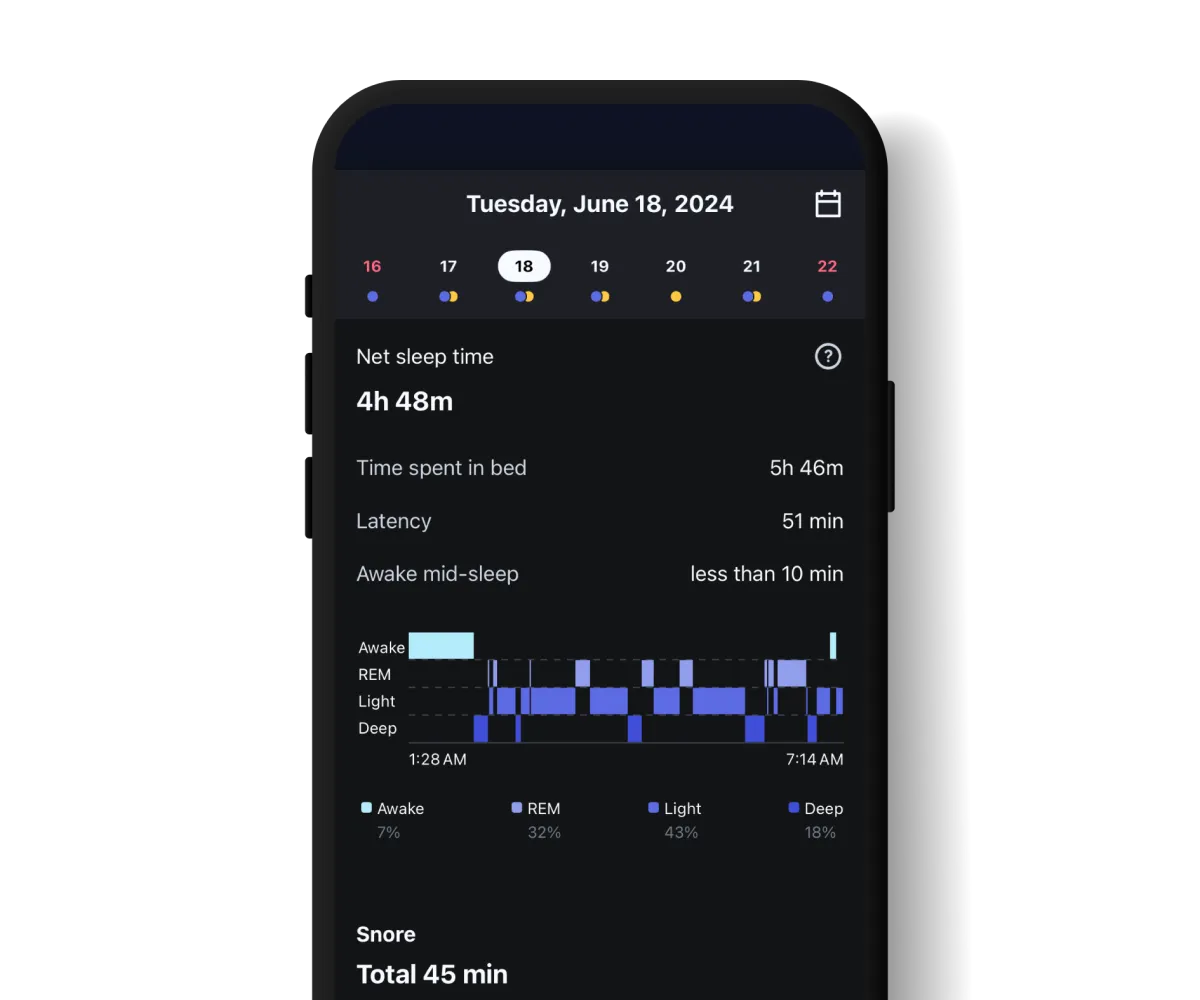
Alarmy's Gentle Wake-Up feature gradually increases alarm volume over a set period rather than blasting you awake at full intensity. That slow ramp-up aligns naturally with lighter sleep phases, so you're less likely to be startled out of a deeper part of your cycle. And if you want to monitor whether your adjustments are actually working, Alarmy's sleep tracking shows your core sleep percentage, REM, and total sleep time across multiple nights — patterns over a week reveal what a single reading can't.

Not exactly. Both terms refer to NREM sleep before deep sleep kicks in, but they're not identical. Light sleep typically refers to N1 — the brief, drowsy phase right at sleep onset. Core sleep refers to N2, which follows N1 and is significantly more involved. N2 includes sleep spindles and K-complexes that N1 doesn't, and it makes up far more of your night.
Sleep stage composition naturally varies based on factors like stress, alcohol, exercise timing, and when you go to bed. Apple Watch uses motion and heart rate data to estimate sleep stages, so readings also shift with external changes — a partner moving, a warmer room, or even sleeping in a different position. Weekly averages are a more reliable signal than any individual night.
Focusing specifically on increasing core sleep percentage isn't the most useful goal — it makes up such a large portion of sleep naturally that dramatic changes are unlikely without addressing total sleep time and quality. The more practical approach is to protect overall sleep architecture: consistent schedule, reduced sleep disruptors, and enough hours. When the conditions are right, your body distributes sleep stages appropriately on its own.
* This article is for informational purposes only and does not replace professional medical advice. Always consult a healthcare provider for health-related decisions.