.svg)

Get started Alarmy
by scanning the QR code
by scanning the QR code

%201.svg)
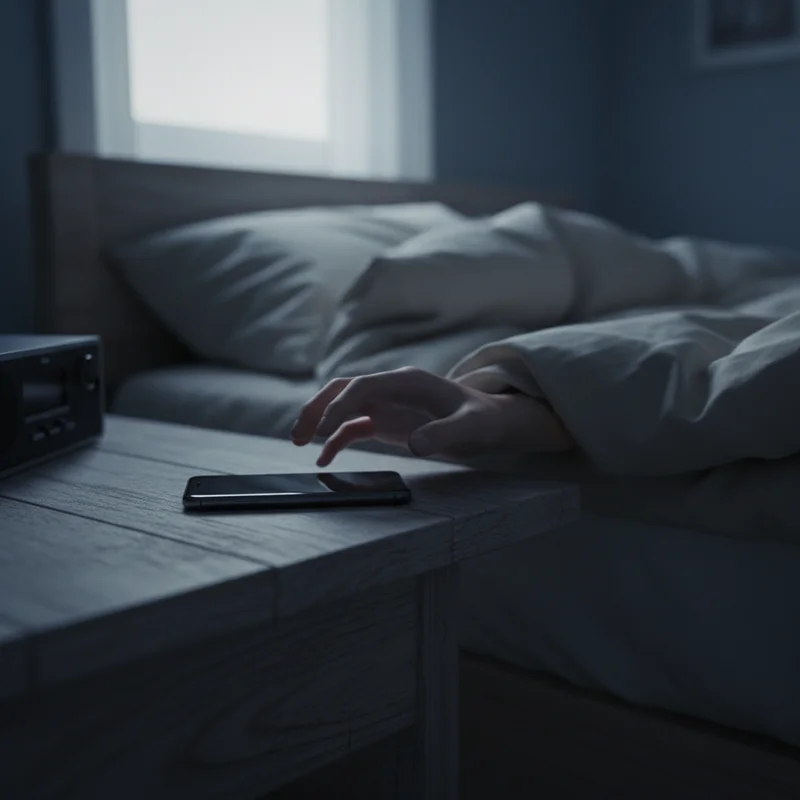
Ten alarms. Five minutes apart. All dismissed — with no memory of doing it.
If that sounds familiar, you're not lazy. Something specific happens in your brain during deep sleep that makes it physically harder to respond to sound, and understanding it is the first step to fixing it.
Sleep happens in cycles, each lasting roughly 90 minutes. The deepest phase — called N3, or slow-wave sleep — typically occurs in the first half of the night. During N3, your brain slows dramatically, your body repairs itself, and your mind effectively goes offline.
The catch: your auditory cortex gets suppressed. Research on sleep and sensory processing shows that during deep sleep, the brain's response to external sounds is significantly reduced. The sound waves from your alarm still reach your ears — but your brain doesn't process them as urgent, or sometimes doesn't register them at all.
This is why sleeping through your alarm isn't about not caring. The arousal threshold — the amount of stimulation needed to wake you — climbs sharply in N3. Standard alarm tones often don't clear that bar.
Even if your alarm is loud enough in theory, there's a second mechanism working against you: auditory habituation.
Habituation is the brain's way of filtering background noise. Repeat a sound often enough without consequence, and the brain reclassifies it as non-threatening — something to be tuned out rather than acted on. Your morning alarm, heard every single day, is a textbook candidate for this process.
That's why the alarm you've used for two years probably feels less shocking than it did when you first set it. Your nervous system has learned: "That sound means nothing bad happens." So it stops treating it as a trigger worth waking up for.
This is also what drives the snooze button habit — repeated dismissals teach the brain that the alarm is safe to ignore, making the next one even easier to sleep through.
Two criteria, both required:
A gentle chime might be pleasant. But pleasant doesn't cross arousal thresholds or bypass habituation. For heavy sleepers, the alarm needs to feel like something actually happened.
These five ringtones are the ones heavy sleepers keep coming back to. Each one maps directly to the two criteria above — either by hitting the arousal threshold hard, resisting habituation, or both.
The sound of an air raid siren is one of the most universally recognizable threat signals in human experience. It triggers an instinctive orienting response — a physiological reaction that precedes conscious thought. For heavy sleepers, that involuntary jolt is exactly the point.
Best for: people who need a true shock-to-the-system wake-up
Few sounds produce as immediate a physical reaction as a fire alarm. The sharp, repetitive pitch is engineered to be impossible to habituate to — it's why public safety systems use it. That same design logic makes it exceptionally effective as a personal alarm.
Best for: heavy sleepers who've burned through gentler options

This one escalates. The building tension and cinematic urgency create a sense that something is happening right now, which is hard to sleep through even at lower volume. It's intense without being a single-note assault.
Best for: those who want maximum urgency with some variation in sound
Think facility evacuation alert — persistent, technical, and clinical. It doesn't have the raw aggression of an air raid, but the specificity of it reads as "you need to act now." Less jarring than Air Raid, but no less effective at pulling you out of sleep.
Best for: people who find the loudest options overwhelming but still need a jolt
This is the familiar beep-beep-beep of an old digital clock — but Alarmy's version is persistent in a way a standard alarm isn't. The steady rhythm and refusal to fade works well for people on the lighter end of heavy sleeping.
Best for: lighter heavy sleepers who need something more persistent than a standard phone alarm
For more options across different styles, the video alarm ringtone collection covers seven tones that pair visual and audio stimulation.
Some heavy sleepers can dismiss even the loudest alarm on autopilot — and fall right back asleep without remembering it. If that's you, sound is only part of the equation.

Adding a mission alarm introduces a physical engagement layer that sound can't. Alarmy's Wake-Up Missions require you to complete a task before the alarm stops — solve a math problem, take a photo of a specific object, or type out a phrase. You can't do those things while still half-asleep.
Pairing a threat-coded ringtone with a wake-up mission addresses both problems at once. The sound gets you to conscious awareness; the mission keeps you there long enough to actually get up.
If you're looking for specific mission combinations, alarm wake-up missions for heavy sleepers covers practical setups worth trying.
Struggling to wake up isn't a character flaw — it's a stimulus mismatch. Change the input, not yourself.
This happens when your alarm fires during a deep sleep phase (N3) and you respond while still partially unconscious. The action — reaching over and dismissing it — doesn't require enough cognitive engagement to form a memory. It's a reflexive behavior, not a conscious choice.
Volume helps, but it's not the only factor. Frequency range, familiarity, and whether the sound triggers a threat response all matter. A moderately loud unfamiliar sound often outperforms a very loud familiar one, because habituation reduces the brain's response to known tones regardless of volume.
Somewhat. Consistent sleep and wake times can reduce how much deep sleep you're in when the alarm fires. But for structurally heavy sleepers, behavioral changes alone often aren't enough — the alarm itself usually needs to change.
Auditory habituation. Your brain has tagged that sound as "no action required" through repeated exposure without consequence. Switching to a different alarm sound — ideally one that sounds like an emergency — resets that classification.
Pair your wake-up plan with a stronger video alarm — 70+ in Alarmy →