.svg)

Get started Alarmy
by scanning the QR code
by scanning the QR code

%201.svg)

You bought a bottle of melatonin gummies, took one before bed, and waited. Nothing happened — so you took another. Maybe a third. Sound familiar?
Most people who try melatonin supplements go through this exact cycle. The irony is that taking more often makes your sleep worse, not better. The problem isn't the hormone itself. It's how the supplement industry packages it.
Melatonin isn't a sleeping pill. Your brain's pineal gland produces it naturally as daylight fades, signaling that nighttime is approaching. Think of it as a darkness messenger — it doesn't knock you out, it tells your internal clock to start winding down.
This distinction matters because it shapes how supplements should be used. Melatonin lowers your core body temperature slightly and reduces alertness, nudging you toward sleep. But it doesn't force unconsciousness the way sedatives do.
Your body produces roughly 0.1 to 0.3mg of melatonin per night. Now look at any supplement shelf: 5mg, 10mg, even 20mg tablets. That's anywhere from 15 to 200 times what your brain naturally makes.
At those doses, melatonin floods your receptors well beyond what's needed for the sleep signal. The excess doesn't help you sleep deeper or longer — it often leads to morning grogginess, vivid nightmares, and a feedback loop where your body reduces its own production.
The effective melatonin dosage for sleep is far lower than what most products offer. Research from MIT found that 0.3mg raised blood melatonin levels to the normal nighttime range — while 3mg produced levels 10 times higher than natural, with no additional sleep benefit. The National Center for Complementary and Integrative Health notes that melatonin supplements vary widely in actual content, often differing significantly from label claims.
If your current supplement is 5mg or higher, try cutting the tablet in half — or switch to a low-dose option in the 0.5-1mg range.
Timing matters as much as dosage. Take melatonin 1-2 hours before your target bedtime, not right when you get into bed. Your body needs that lead time to process the signal and begin the wind-down cascade.
A few practical guidelines:
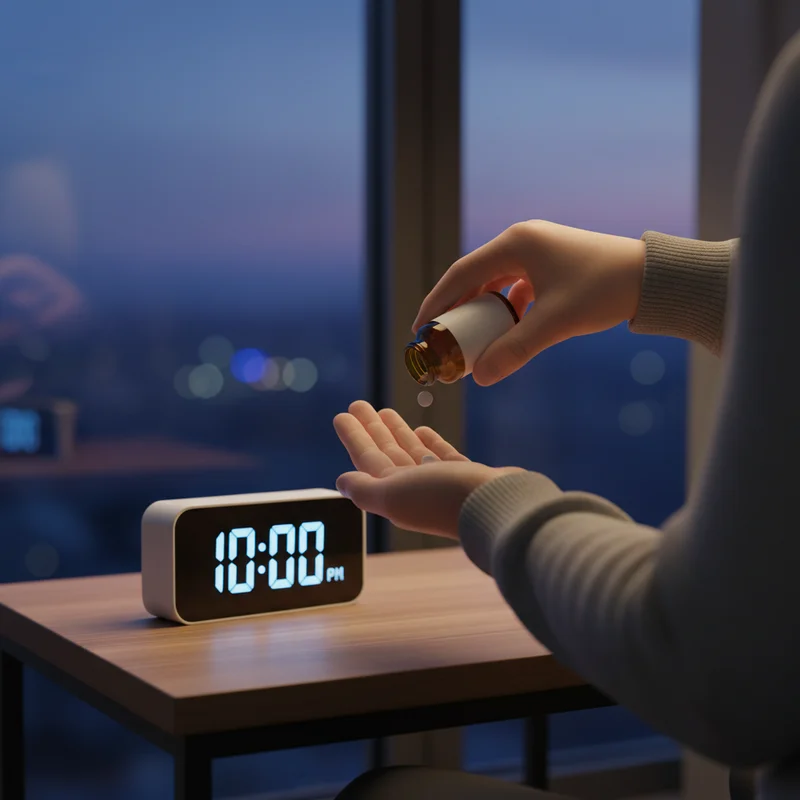
Melatonin is generally considered safe for short-term use, but "natural" doesn't mean risk-free.
Common short-term side effects include headaches, dizziness, nausea, and daytime drowsiness — especially at higher doses. These usually fade within a few days or after reducing the dose.
Long-term safety data is limited. The American Academy of Sleep Medicine notes that melatonin supplements lack the regulatory oversight of prescription medications, meaning potency and purity vary between brands. One study found that actual melatonin content in supplements ranged from 83% less to 478% more than what the label claimed.
Melatonin can interact with several medication categories:
If you take any prescription medication, talk to your doctor before adding melatonin to your routine.
Melatonin works best when the problem is timing — not an inability to sleep at all.
This is where melatonin shines. Crossing multiple time zones confuses your circadian clock, and a small dose at the new local bedtime helps your body recalibrate faster. The same applies to shift workers rotating between schedules or anyone recovering from a few nights of disrupted sleep. If you're dealing with jet lag and travel recovery, melatonin is one of the most well-supported tools available.
For ongoing insomnia, melatonin is less reliable. If you can't sleep because of anxiety, pain, or poor sleep habits, melatonin won't address the root cause. The Sleep Foundation notes the hormone may help you fall asleep 7-12 minutes faster on average — a modest benefit that doesn't solve structural sleep problems.
Cognitive Behavioral Therapy for Insomnia (CBT-I) remains the first-line recommendation for chronic cases. Building effective sleep habits — consistent wake times, stimulus control, and reduced pre-bed stimulation — produces longer-lasting results than any supplement.
If you decide melatonin is worth trying, the key variable isn't the brand or the dose. It's consistency.
Taking melatonin at 9 PM one night and midnight the next sends mixed signals to your circadian system. Pick a fixed time — ideally 1-2 hours before your target bedtime — and stick with it every night during your trial period.
One practical approach: set a nightly habit alarm as your "take melatonin now" cue. Alarmy's Habit Alarm can ping you at the same time each evening, turning supplementation into an automatic part of your bedtime routine rather than something you remember sporadically.
Feelings about sleep quality are unreliable. You might think melatonin helped because you expected it to — placebo effects are strong with sleep supplements.
Track objective data instead. Alarmy's Sleep Analysis lets you compare total sleep duration, sleep cycles, and wake-up patterns on nights you take melatonin versus nights you skip it. After two weeks of consistent tracking, the data tells you whether supplementation is genuinely improving your sleep or just providing peace of mind.


Short-term nightly use (up to 2-3 months) is generally considered safe for most adults. Beyond that, limited long-term data exists. Consider using melatonin as a temporary tool while building better sleep habits, then tapering off to see if you still need it.
Melatonin doesn't create physical dependency the way sleep medications like benzodiazepines do. Your body won't go through withdrawal. That said, some people develop a psychological reliance — feeling unable to sleep without taking a pill, regardless of whether the melatonin itself is doing anything.
Excessive doses typically cause headaches, nausea, dizziness, and intense daytime drowsiness. In rare cases, it can disrupt blood pressure or hormone levels. Reducing your dose to 0.3-1mg often improves results.
Melatonin is frequently used by older adults since natural production declines with age. Start with the lowest available dose (0.3-0.5mg) and consult your doctor, especially if you take blood pressure or blood-thinning medications.
* This article is for informational purposes only and does not replace professional medical advice. Always consult a healthcare provider for health-related decisions.